
BLOG
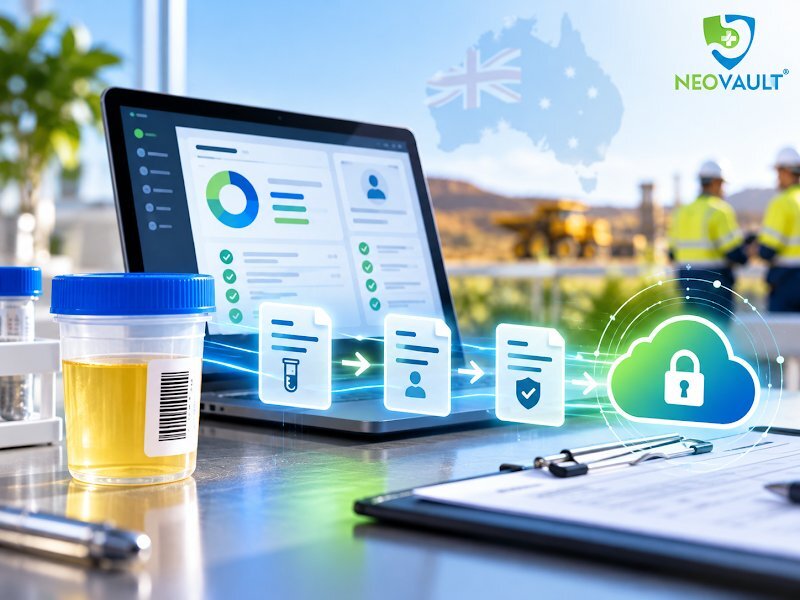

A urine drug test helps Australian employers conduct workplace screening, but records become difficult to verify when collection details, specimen handovers and laboratory reports sit in separate files. Safety and HR managers need a clear link between each specimen, its initial screening outcome and any confirmatory result. Digital recordkeeping supports that link through consistent identifiers, documented actions and controlled access. This guide explains the information to capture, the role of AS/NZS 4308:2023 and how NEOVAULT supports traceable testing workflows across multiple worksites.
A urine drug test screens a urine specimen for selected drugs or their metabolites. In Australian workplaces, the test should sit within a documented program that defines when screening occurs, who collects samples and how results are reviewed. A detected substance does not, by itself, establish that someone was impaired while working.
Urine screening identifies markers of exposure, subject to the chosen method and procedure:
Testing triggers depend on workplace policy and applicable requirements:
For multi-site mining, construction and transport employers, every collection event needs its own traceable record. Recording the testing trigger and relevant policy version also makes a later review easier.
A useful urine drug test record links the authorised worker identifier to the collector, collection event, specimen reference, integrity checks and initial screening result. Where laboratory confirmation is needed, that report must connect to the original specimen. A digital record should also preserve relevant timestamps, reviews and changes, rather than storing a final outcome without context.
Structured fields should let authorised reviewers reconstruct each collection event:
Collect only information needed for the relevant purpose. Extra personal details can complicate access controls without improving specimen traceability or the reliability of the result.
Keep screening and confirmation separate to avoid premature conclusions:
A drug testing audit trail should show subsequent actions and changes:
Digital chain of custody is the electronic record of specimen identification, handling and transfer from collection through laboratory receipt and reporting. By linking timestamps and responsible parties to a unique specimen ID, it helps teams identify gaps or discrepancies. It supports traceability, but cannot substitute for proper physical sealing, storage or transport.
The specimen label must match its electronic identifier. Capture:
This matters in split-cup collection, where device and documentation must match. QR/barcode scanning reduces re-entry, but collectors must verify physical labels.
Document responsibility at each transfer, including where applicable:
Timestamps cannot replace correct physical handling. If a seal reference is inconsistent or a handover is missing, the discrepancy should remain visible until it is investigated. Staff should not reconstruct events from memory as though they were contemporaneous records.
Before final reporting, reviewers should check:
A single case should reveal the initial status, what happened next and who authorised the final report, without relying on separate email chains.

Urine specimen scanning and digital chain of custody workflow
AS/NZS 4308:2023 addresses urine specimen collection, handling, storage, onsite screening and laboratory processes, including relevant reporting and recordkeeping. Digital tools can help organisations document those activities consistently. However, using electronic forms does not automatically demonstrate conformity with the standard or replace a suitable workplace policy, trained personnel and appropriate laboratory practices.
The official AS/NZS 4308:2023 standard covers chain of custody, specimen integrity, test reports, recordkeeping and result reconciliation. Digital workflows should document:
The NEOVAULT AS/NZS 4308 guide explains the wider testing framework.
The OAIC employee records guidance explains that the private-sector employee records exemption has limits: it does not cover contractors handling another employer's records or unsuccessful job applicants. Controls include:
Employers and contracted testing providers may have different privacy obligations. Access and retention settings should be reviewed for each participating organisation.
Paperless drug testing cannot replace:
Employers can move to digital urine drug test records by mapping the existing workflow, defining the fields required at each stage and assigning responsibility for updates and review. A pilot should test specimen matching, connectivity problems and laboratory follow-up before wider deployment. The aim is to reduce avoidable administration while maintaining reliable, reviewable evidence.
Paper processes can create recurring gaps across sites:
Compare how each approach manages information; both require accurate inputs.
| Process | Paper-based approach | Digital approach |
|---|---|---|
| Collection details | Handwritten fields | Structured electronic forms |
| Specimen matching | Manual comparison of labels | Linked identifiers with verification |
| Handover history | Separate forms and signatures | Recorded events and timestamps |
| Result follow-up | Manual tracking across files | Central status and report links |
| Audit preparation | Retrieve individual documents | Search authorised digital records |
For a manageable rollout, teams should:
The pilot should include a not-negative screen requiring laboratory follow-up, so the team can check that status changes and final reports remain linked.
NEOVAULT is a SaaS platform developed by Neopharma Technologies Limited for managing workplace drug, alcohol and impairment testing information. Its myNEO mobile app supports digital capture, QR/barcode scanning and offline workflows. The Drug & Alcohol Testing module and Reporting & Analytics help organisations connect field records with centralised oversight and reporting.
Across sites, myNEO supports:
Physical checks and exception handling remain necessary. For example, a remote collector could scan a device, enter collection details without connectivity and synchronise later. An authorised manager could then review the available event record in the central portal, subject to the configured access permissions.
The NEOVAULT platform offers:
Teams can use centralised reports to review program activity across sites without assembling each collection file manually. Its Impairment Risk Management (IRM) module supports a separate fitness-for-duty assessment, not urine-test confirmation.
A not-negative urine drug screen is not a confirmed positive. Digital chain-of-custody records may replace some paper steps where procedures allow, but they cannot replace physical specimen controls. Record retention depends on the applicable requirements, and offline capture depends on the system used. The answers below explain these distinctions for Australian employers.
No. A not-negative initial result indicates that further action is needed under the applicable testing procedure. It is not automatically a confirmed positive finding. Where confirmation is required, the laboratory result should be recorded separately, linked to the original specimen and reviewed through the organisation's authorised reporting process.
Sometimes. Electronic records may replace parts of a paper process when the relevant procedures and participating collectors, employers and laboratories accept them. They must still capture accurate identification and handover information. Digital documentation cannot replace physical specimen security, appropriate laboratory procedures or the need to resolve discrepancies in the underlying records.
There is no universal retention period for every Australian workplace urine drug test record. The appropriate schedule depends on applicable laws, contractual arrangements, workplace policies and the purpose of the information. Employers should document who is responsible for retention, restrict unnecessary access and establish a controlled process for eventual disposal.
Yes, where the chosen system supports offline capture. Collectors can record information locally and synchronise it once a connection is available. Before deployment, employers should confirm how the system protects stored data, handles failed synchronisation, prevents duplicate entries and links later laboratory reports to the correct collection event.
Accurate urine drug test records link each specimen to collection details, chain-of-custody events, screening outcomes and any laboratory confirmation. For Australian employers, digital recordkeeping can reduce repeated data entry and make authorised reviews more efficient across multiple worksites. It does not replace trained collectors, suitable laboratory procedures or the organisation's privacy responsibilities. NEOVAULT supports the administrative process through myNEO field capture, centralised test management and reporting. Organisations should assess how these capabilities fit their existing testing policy and recordkeeping requirements.