-Long-Transparent.png?width=200&height=47&name=NEOVAULT-Sheild-Neo-(R)-Long-Transparent.png)
BLOG


The debate surrounding cannabis impairment vs thc detection is reshaping legal frameworks and safety policies across Australian workplaces. For human resources professionals and safety managers, determining whether an employee is genuinely fit for duty requires much more than a standard toxicology screen.
While traditional methods are capable of identifying past substance exposure, they often fail to answer the most critical question: is the worker currently intoxicated? This technical guide explores the profound biological differences between THC and alcohol, details the limitations of standard testing protocols, and explains how modern organisations can digitise their safety programmes to accurately measure actual impairment and manage workplace risk.
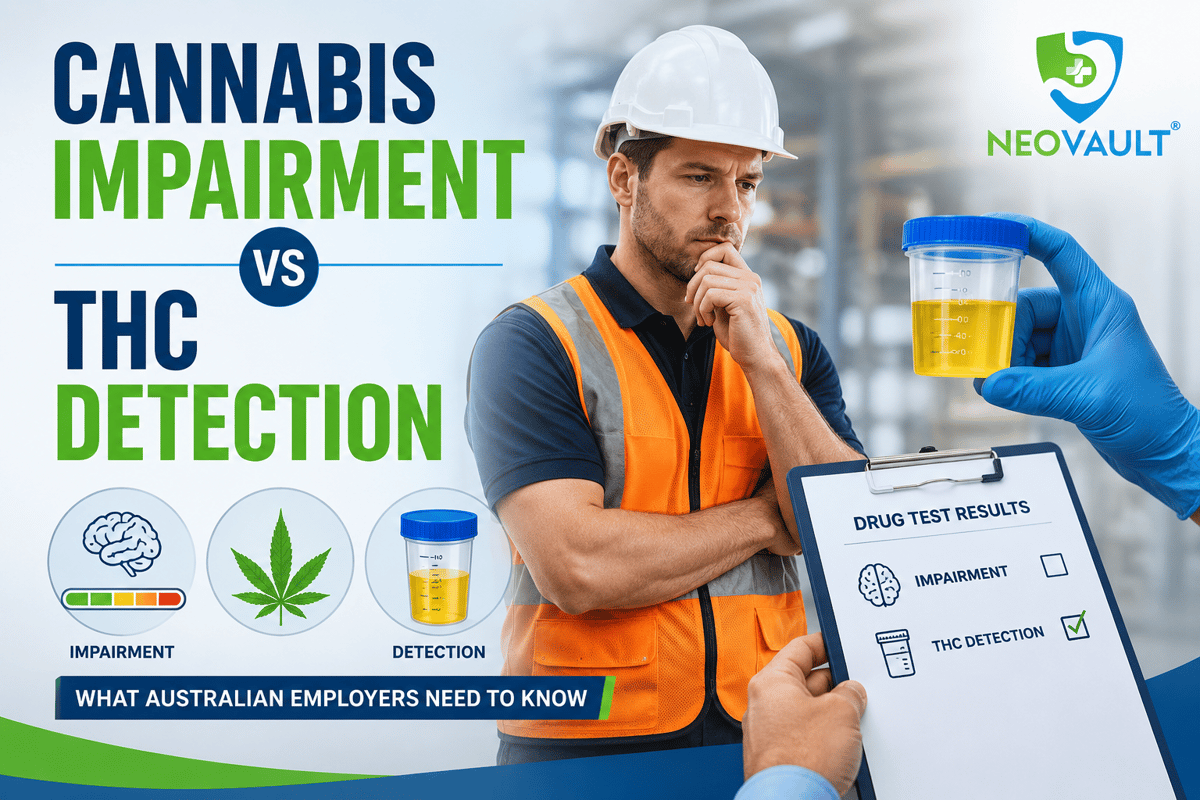
Cannabis impairment vs THC detection for AU employers
Understanding this difference is critical because of how the body metabolises the substance. Unlike alcohol, THC is fat-soluble and can remain in the system for weeks after use. A positive drug test confirms historical exposure but fails to reflect a person's current level of intoxication or capability.
To understand the core issue of thc vs impairment, safety managers must look at the distinct pharmacokinetics of alcohol compared to cannabis:
This biological reality means that establishing a "per se" legal limit for THC lacks scientific validity. The concentration of THC in a bodily fluid does not mirror the concentration at neural receptor sites responsible for cognitive and motor functions, making chemical thresholds highly inaccurate for determining current intoxication.
The challenge of measuring impairment is further complicated by how the human liver processes THC. The liver breaks down active Delta-9-THC into various metabolites, primarily 11-OH-THC (psychoactive) and eventually into THC-COOH (completely inactive). Most standard protocols detect these secondary, inactive metabolites rather than the active parent compound. This persistence creates several challenges:
To maintain a fair and legally defensible safety programme, organisations must distinguish between the presence of historical metabolites and the immediate reality of functional capability.
Traditional urine and oral fluid tests confirm past substance exposure rather than current cognitive capability. While these methods support broad compliance initiatives, they cannot measure a worker's reaction time or focus in real time, making them insufficient for assessing immediate functional impairment on the job.
The foundation of workplace drug testing Australia relies heavily on established standards, specifically AS/NZS 4308 for urine testing and AS/NZS 4760 oral fluid testing. While these frameworks provide a vital baseline for enforcing policies, a primary limitation of these methods is their reliance on extended detection windows that flag historical exposure rather than current intoxication:
Because of these timeframes, an employee failing a random test on a Tuesday morning due to off-duty consumption on Sunday cannot scientifically be proven as a safety risk on Tuesday based solely on that result.
The most critical limitation of traditional testing is that chemical detection fails to predict immediate safety risks. Neither urine nor oral fluid testing can assess a worker's divided attention, spatial awareness, or executive function. This disconnect forces a strategic shift for HR and safety professionals.
The scientific community has repeatedly warned against equating chemical detection with functional inability. The debate between actual cannabis impairment and mere THC detection is reshaping legal and workplace frameworks. Unlike alcohol, the presence of THC in a person's bloodstream is a poor indicator of real-time intoxication.
A clinical trial by Spindle et al. (2021) demonstrated that blood THC concentrations exhibit severe limitations when used to determine acute impairment. Instead, the study highlighted that rapid cognitive and psychomotor assessments (such as the DRUID app) are significantly more sensitive and accurate in measuring a person's true functional impairment.
When regulatory bodies outline the duties of an employer under Work Health and Safety (WHS) laws, the core obligation is to eliminate or minimise the risk of injury. Relying exclusively on detection methods exposes organisations to disputes over unfair dismissal while failing to address the immediate reality of workforce capability.
To solve the challenge of cannabis impairment vs thc detection, Australian employers are adopting cognitive and psychomotor assessments. These digital tools evaluate an employee's reaction time, decision-making, and focus against their personal baseline, providing a real-time, objective measure of their readiness to work safely in high-risk environments.
Effectively measuring cannabis impairment requires shifting the focus from the bladder to the brain. Cognitive impairment testing provides a direct evaluation of the neurological functions necessary for safe work. Rather than searching for chemical compounds, these assessments measure the actual outputs of the central nervous system. This method introduces several core advantages over standard testing:
Impairment risk management digital testing at scale requires robust digital infrastructure. Paper-based processes or isolated testing apps lack the auditability and integration necessary for enterprise compliance. Modern platforms allow companies to embed cognitive assessments directly into their daily site access protocols:

Digital solutions for real-time IRM in workplaces
|
Feature |
Traditional Drug Testing (Toxicology) |
Cognitive Testing |
|
Primary Objective |
Detect historical exposure to specific chemical substances. |
Measure current brain function and readiness to work. |
|
Testing Timeframe |
Retrospective (identifies past use from hours to weeks ago). |
Real-time (identifies immediate capability at the moment of testing). |
|
Scope of Risk Detected |
Limited strictly to the targeted chemical compounds. |
Identifies impairment from fatigue, illness, stress, and substances. |
|
Data Output |
Pass/Fail based on laboratory cut-off thresholds. |
Objective score measuring deviation from an individual baseline. |
Related reading: workplace impairment detection
Cannabis impairment refers to the actual loss of cognitive and motor functions due to intoxication. THC detection simply means identifying the chemical or its inactive metabolites in the body, which can frequently occur days or weeks after use without any present impairment.
No, standard urine or oral fluid tests only measure the presence of substances above a specific threshold. Because the body's response to cannabis is non-linear, a positive test indicates historical exposure, not necessarily that the employee is currently unfit for duty.
To support robust safety policies, employers can implement rapid cognitive and psychomotor assessments. These digital tools measure an individual's reaction time and focus in real time, offering a direct, objective evaluation of their functional capacity to perform safety-critical tasks safely.
Navigating cannabis impairment vs thc detection is a modern risk management challenge. Because THC presence does not accurately mirror cognitive capability, progressive safety managers are transitioning to proactive functional assessments. NEOVAULT supports this transition with a secure SaaS platform designed to digitise your testing workflow. Our integrated Impairment Risk Management (IRM) and Drug & Alcohol Testing Module allow you to automate reporting, organise compliance data, and seamlessly ensure your workforce is genuinely fit for duty.