-Long-Transparent.png?width=200&height=47&name=NEOVAULT-Sheild-Neo-(R)-Long-Transparent.png)
BLOG

Effective drug test result management is critical for Australian businesses aiming to maintain a safe and productive work environment. For human resources and safety managers, handling these sensitive records involves navigating strict privacy laws and ensuring alignment with national standards. When you manage drug test records properly, you protect both the employee and the organisation from potential legal or safety risks.
This guide covers the essential practices for workplace drug testing compliance AU, exploring how modern software helps establish a tamper-proof digital chain of custody. We will discuss the shift from paper-based systems to digital solutions, the core Australian Standards for testing, and how implementing employee drug testing software can streamline your compliance programme without sacrificing data security or workforce privacy.
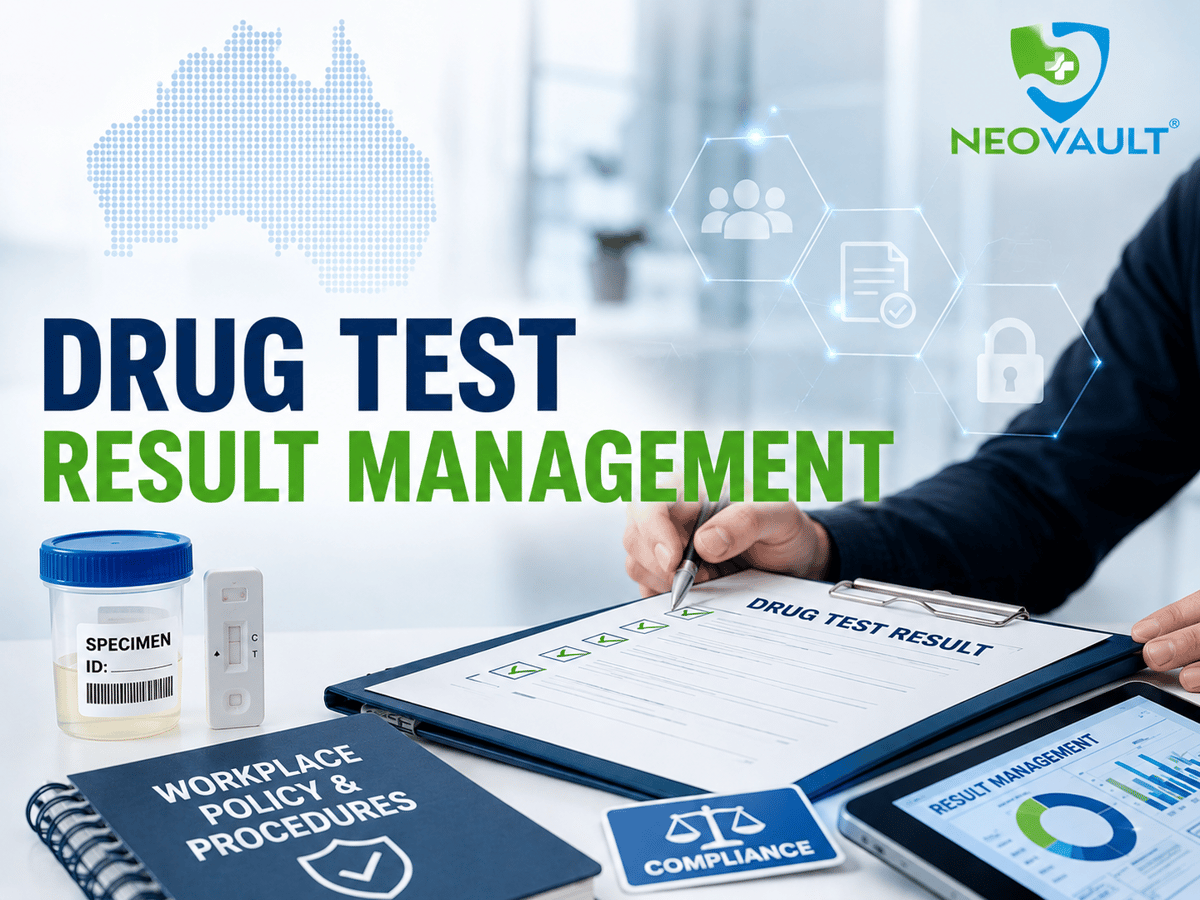 Guide to drug test result management in AU workplaces
Drug test result management is the systematic process of collecting, securely storing, and analysing workplace drug and alcohol testing data. It ensures businesses maintain a tamper-proof digital chain of custody, protect employee privacy, and comply with strict safety regulations while providing audit-ready records.
For decades, many Australian industries relied on manual spreadsheets and paper forms to track safety tests. However, manual methods introduce significant risks of human error, misplaced documents, and delayed communication. In heavy industries like mining and construction, where safety is paramount, a lost paper record can mean the difference between a compliant site and a major safety violation. Implementing effective record management means moving away from these outdated practices and adopting digital workflows that capture data at the source.
Digital transformation in this sector provides several operational advantages:
This rapid response is a core benefit of using dedicated employee drug testing software rather than generic spreadsheet applications.
Managing health data requires strict adherence to privacy regulations, specifically the Privacy Act 1988 in Australia. Managing these records is not just about recording a pass or fail; it is about ensuring that highly sensitive medical information is kept confidential. Paper records stored in a filing cabinet or unprotected digital spreadsheets are highly vulnerable to unauthorised access and data breaches.
A structured approach ensures that data is protected through:
When you securely manage drug test records, you build trust with your workforce, reassuring them that their personal health information is handled with the highest level of professional integrity and legal compliance.
To support compliance in Australian workplaces, drug testing programmes must align with AS/NZS 4308 for urine testing and AS/NZS 4760 for oral fluid testing. Effective digital management systems streamline these requirements by providing audit-ready reporting and integrating seamlessly with existing workplace health and safety policies.
Australian Standards provide a strict framework for how testing should be conducted, from the initial collection to laboratory confirmation. Achieving AS/NZS 4308 and AS/NZS 4760 compliance requires businesses to follow precise steps to ensure accuracy and fairness:
Any deviation from these standards can render a test invalid, potentially leading to unfair dismissal claims or regulatory penalties. Effective compliance software is designed with these standards in mind. The software guides the collector through the mandated steps, ensuring no procedural requirement is skipped. By enforcing these workflows digitally, organisations can confidently demonstrate that their testing programmes meet the rigorous expectations of Australian regulators.
The integrity of a test relies entirely on the chain of custody. This refers to the documented chronological history of the specimen, from the moment it is provided by the employee to its final disposal. A break in this chain can invalidate the entire process. Traditional paper forms are susceptible to being altered, lost, or illegibly completed.
Transitioning to a digital chain of custody eliminates these vulnerabilities. Advanced systems generate unalterable digital logs that capture:
This robust digital trail provides indisputable evidence that the sample was handled correctly, which is vital during compliance audits or legal disputes. A strong digital chain of custody protects the organisation and ensures fairness for the employee.
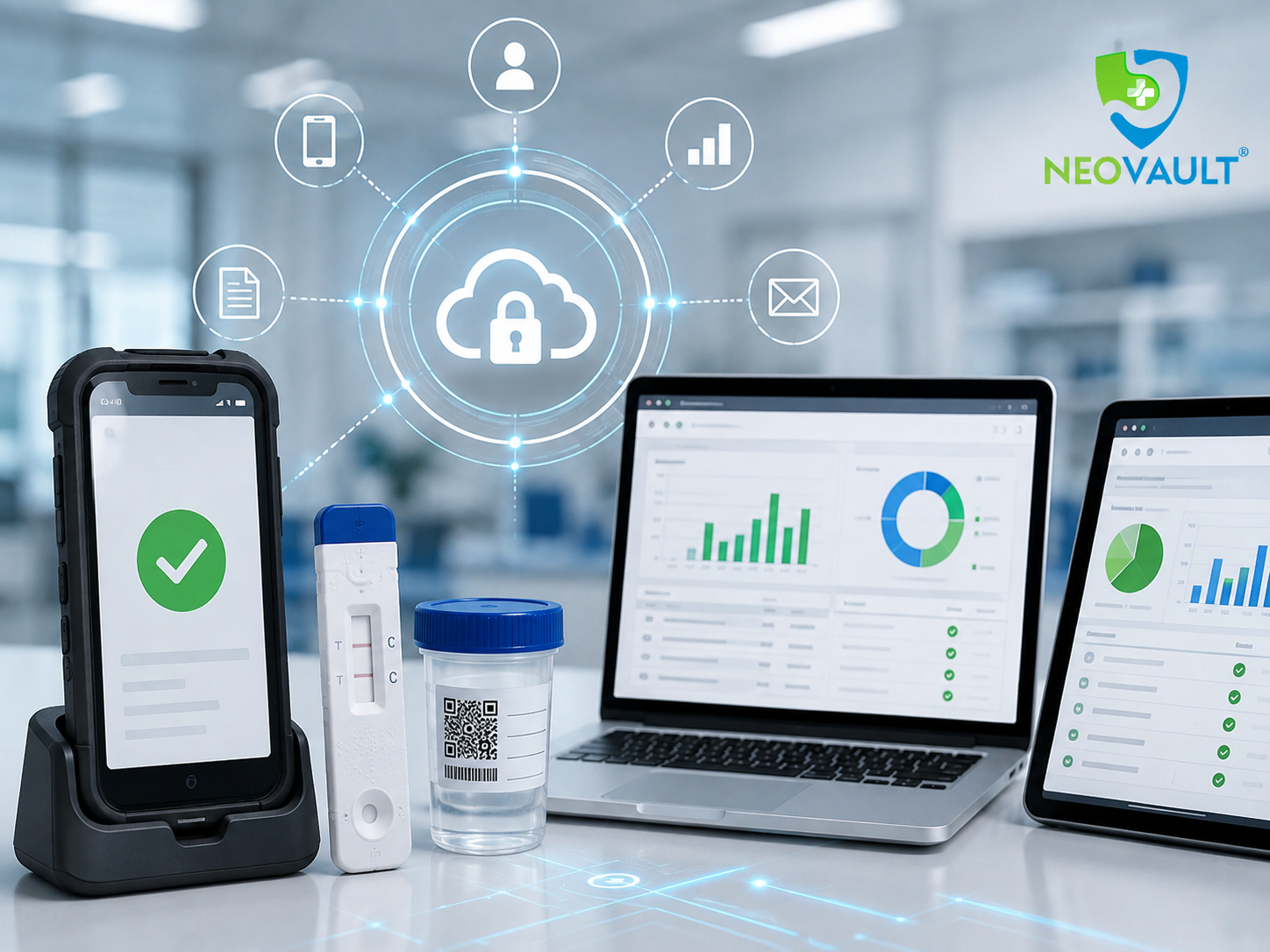
A robust digital compliance system offers paperless data capture, real-time analytics, and secure multi-site permissions. Modern platforms centralise records, replacing manual spreadsheets with automated reporting and digital identity verification for every physical test kit used on site.
Speed and accuracy are crucial when managing workplace safety. Digital systems allow collectors to input data directly into a mobile device at the point of collection. For example, using tools like the myNEO Mobile App, field workers can capture test outcomes instantly, even in areas with poor internet connectivity. The app synchronises the data to the central portal as soon as a connection is restored.
This real-time capture feeds directly into automated reporting engines. Instead of spending hours compiling monthly compliance reports, safety managers can generate comprehensive overviews with a single click. Automated reporting simplifies data administration by providing instant visibility into:
This efficiency frees up HR and safety teams to focus on proactive risk mitigation rather than administrative data entry.
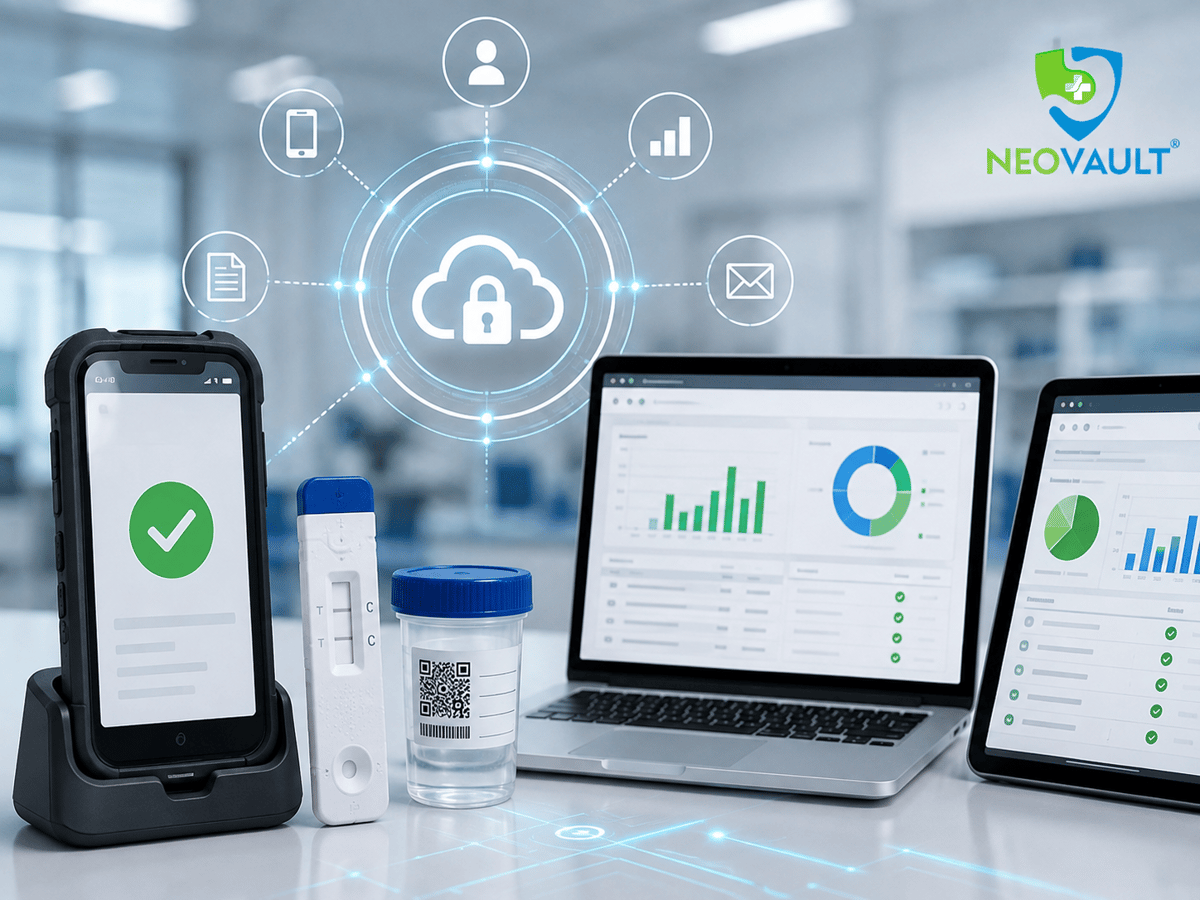 System for real-time data capture and automated reporting
One of the most significant advancements in drug test result management is the ability to assign a digital identity to a physical object. Modern software allows users to scan barcodes or QR codes on the physical test kits, linking that specific kit directly to the employee's digital profile. This process eliminates transcription errors and ensures that the correct results are attributed to the correct individual.
By digitising the physical kit, organisations strengthen their digital chain of custody. The system records the batch number, expiry date, and the exact time the kit was scanned. This level of traceability is essential for maintaining AS/NZS 4308 and AS/NZS 4760 compliance, as it proves that the materials used were valid and within their usable lifespan at the time of testing.
For enterprises operating across multiple locations, standardising safety protocols is a major challenge. A central drug test result management platform provides a unified view of all operations, ensuring consistency across every site. This capability is critical for large mining, transport, or construction firms that need to monitor compliance across vast geographical areas.
Key features that support multi-site operations include:
Integrating cognitive impairment assessments with traditional drug and alcohol testing provides a holistic view of workforce readiness. Systems combining both data streams allow safety managers to proactively identify fatigue, stress, or intoxication risks before a worker begins their shift.
While testing for substances is a critical component of safety, it does not account for all forms of workplace risk. An employee might be perfectly sober but severely fatigued, stressed, or recovering from a minor head injury, all of which can impair their ability to operate heavy machinery safely. Expanding drug test result management to include cognitive assessments offers a more comprehensive approach to risk mitigation.
Short, gamified cognitive tests can measure reaction times, decision-making capabilities, and motor skills in just a few minutes. Research highlights the effectiveness of such tools; for instance, a study on cognitive recovery monitoring (DeJong et al., 2025) demonstrates how digital assessments can accurately track cognitive function. By incorporating similar impairment checks alongside standard substance testing, companies can catch subtle signs of fatigue or cognitive decline that a standard drug test would miss.
The true value of gathering both substance testing and cognitive impairment data lies in centralising it. When you manage drug test records on the same platform as impairment scores, you create a powerful, unified risk management dashboard. This holistic view allows safety teams to identify overlapping trends, such as specific shifts where fatigue and non-negative results frequently intersect.
Managing sensitive health records across multiple systems exposes organisations to critical compliance gaps and privacy risks. NEOVAULT solves this by unifying your entire workflow. From field collection to executive reporting, the purpose-built platform eliminates the continuous drag of physical paperwork while ensuring strict adherence to AS/NZS 4308 and AS/NZS 4760 standards.
By transitioning to the NEOVAULT ecosystem, safety and HR teams can efficiently manage impairment risks through:
Related reading: drug and alcohol register
Employers should store records securely in accordance with the Privacy Act 1988 and their specific workplace health and safety policies. Typically, these records are retained for the duration of the individual's employment plus a statutory period, ensuring they remain available for future audits or legal inquiries.
Yes, enterprise-ready software employs strict access controls and data encryption protocols. By assigning role-based permissions, the system ensures that only authorised personnel can view sensitive health data, significantly mitigating the risk of unauthorised access or data leaks.
Digital systems provide a robust, timestamped audit trail from the point of collection to the laboratory. This unalterable digital chain of custody strongly supports businesses during compliance audits, providing clear evidence that all procedures were followed correctly.
Transitioning to a digital drug test result management system is a strategic move that enhances safety and simplifies compliance with Australian Standards. By adopting software that supports a digital chain of custody, HR and safety managers can eliminate administrative bottlenecks. If your organisation is ready to modernise, NEOVAULT provides a secure platform to oversee your entire safety programme. Contact us to schedule a demo and see how our tailored solutions streamline workplace drug testing compliance AU.