-Long-Transparent.png?width=200&height=47&name=NEOVAULT-Sheild-Neo-(R)-Long-Transparent.png)
Mobile drug testing: how it moved from medical vans to smart software

Neovault Team
For many years, mobile drug testing meant booking a medical van to visit your site. Today it often means software on a phone that turns any compliant test kit into a digital record. This guide explains why Australian employers test on site, where the van model falls short, and how app-based testing gives site managers control while keeping laboratory confirmation in place.
Why do Australian businesses test on site instead of at clinics?
They test on site to cut downtime and travel costs. A worker who gives a sample at the workplace returns to duty within minutes, and a supervisor can act on a non-negative result straight away. For workplace drug testing in Australia, that speed is often the deciding factor.
- Less downtime. Workers do not lose hours travelling to a clinic, so output targets hold.
- Lower logistics cost. There is no transport, fuel or extended labour time to pay for.
- Stronger deterrent. Unannounced tests on the premises deter drug use better than scheduled clinic visits.
- Faster risk control. A supervisor can remove an impaired worker from a hazard before an accident happens.
Read our guide to drug and alcohol testing in Brisbane for a city-level view of the same trade-off.
What are the limits of mobile medical vans?
Medical vans bring convenience, but they depend on someone else's schedule, charge per test, and leave you with paper records. Those three limits become more costly as your testing volume grows.
Outsourcing costs add up
When you hire a provider to visit your site, you pay for more than test kits. The extra costs weigh on the safety budget and can make regular random testing hard to sustain.
- Travel time and fuel for the vehicle and its medical staff.
- Premium rates for night shifts and public holidays.
- Per-head service fees that grow quickly across a large workforce.
Paper records create risk
A van visit usually ends with a stack of paper Chain of Custody forms. In dusty industrial settings those forms can be torn or lost in transit. HR staff then retype them into internal systems, and the paper makes it hard to compare results across sites. Our guide to paperless drug testing workflows covers the alternative.
Dependence on a third-party schedule
- Post-incident urgency. If a serious accident happens at midnight, a van may not arrive in time to collect defensible samples.
- Weaker random testing. A large, visible van at the gate warns the workforce and removes the surprise.
- Little flexibility. Shift changes or weather delays are hard to handle with a fixed booking.
What does mobile drug testing mean now?
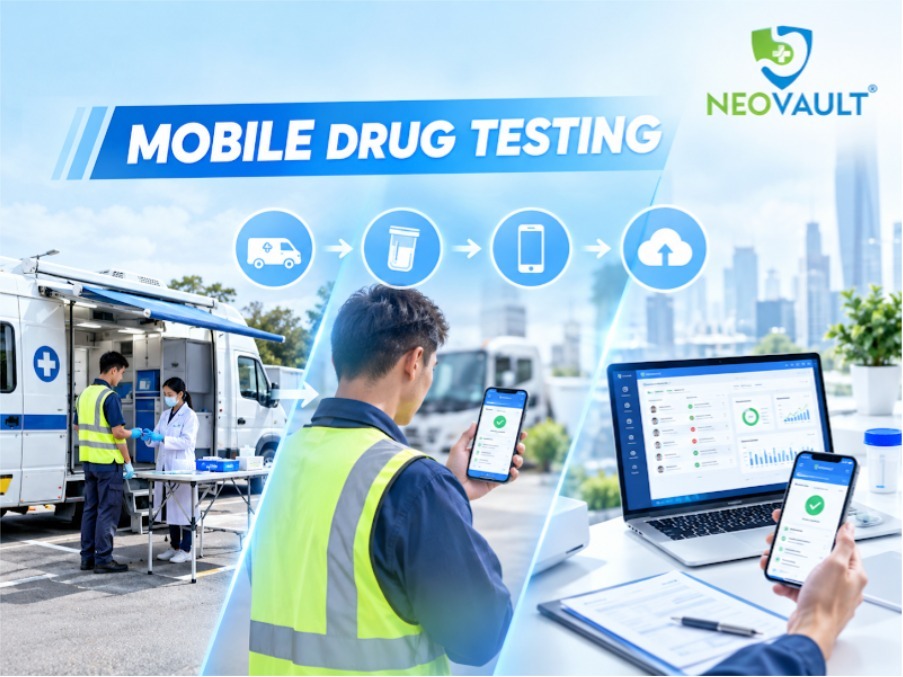
Mobile drug testing now often refers to software. A collector uses a smartphone to scan the kit, read the result, capture the donor details and sync everything to a secure cloud platform. The software complements physical kits and does not replace them.
Digitise any compliant kit with a phone
- The camera scans the QR code or barcode on kits that meet AS/NZS 4760 or AS/NZS 4308. Our guide to QR code drug test kit scanning explains the process.
- The app encrypts the outcome and sends it to the cloud within seconds.
- Results collected by an external alcohol testing service can be synced into the same digital record.
Cognitive impairment tests on a tablet
Software also lets a site manager check fitness for duty before a shift. A study of the DRUID smartphone app found that results from its mobile cognitive tests correlated strongly with blood alcohol concentration. You can read the research on the DRUID app for the details. The test takes about a minute on a tablet, so a supervisor can run it at the start of a shift.
How do NEOVAULT and myNEO support on-site testing?
NEOVAULT and the myNEO app turn any smart device into a digital testing station. They capture data offline, keep a digital chain of custody and give managers live reports for WHS programs.
- Digital chain of custody. Encrypted digital logs replace paper records, so audits are straightforward.
- Offline capability. Mines and construction sites without coverage still record every test, and the app syncs once it reconnects.
- Workflow builder. Safety managers design the screening steps to match their own WHS policy and site rules.
- Real-time dashboard. Analytics and heat maps show where risk is building. See our drug and alcohol testing analytics guide.
Should you drop vans completely?
Not necessarily. Some sites still want an independent collector, for example for a large pre-employment intake or a sensitive investigation. The best setup lets internal staff run routine and random tests with the app, and lets an outside provider sync their results into the same system. That keeps one record whoever collects the sample.
| Job | Van or clinic | App with internal staff |
|---|---|---|
| Routine random testing | Booked in advance, so the surprise is lost | Run any time on a shift |
| Post-incident testing | Depends on van availability | Starts as soon as a trained collector is on site |
| Large pre-employment intake | Useful for volume and independence | Useful when results must sync to your records |
How do you move from vans to app-based testing?
Move in stages. Keep your existing provider for the first weeks, run the app alongside it and compare the records. Once your team trusts the process, shift routine and random tests to internal collectors and keep the provider for specialised work.
- Check your kits. Confirm that the kits you use meet AS/NZS 4760 or AS/NZS 4308 and carry a scannable code.
- Train collectors. Cover consent, the collection steps, scanning and what to do when a result is non-negative.
- Run a pilot. Pick one site and one shift. Track the time per test and the share of records that are complete.
- Link your providers. Ask outside collectors and laboratories to sync results into the same system.
- Review after 30 days. Compare cost, downtime and audit readiness against the van model, then decide what to expand.
Keep your written policy up to date during the change. Workers should know who may test them, how the result is recorded and who sees it. Clear communication also protects you if a result is disputed later. Review the first month with your safety committee, and write down what you will change before you widen the rollout.
Frequently asked questions
Do digital testing apps meet Australian privacy standards?
Enterprise software encrypts health data, stores it securely and limits access to named roles. That supports your privacy and WHS duties. Confirm the details with your own legal adviser.
Can we still use physical test kits with testing software?
Yes. The software scans barcodes on standard saliva or urine kits and turns the result into a digital record. It works with the kits, and laboratory confirmation still applies to non-negative results.
What happens if a test is done where there is no internet?
Apps such as myNEO store data on the device during the test and sync it when a network connection returns.
Putting a testing station in every supervisor's pocket gives Australian businesses control over cost and over their safety data. If you want to move your mobile drug testing from paper and vans to a single digital system, ask the Neopharma Technologies team for a live NEOVAULT demo.