-Long-Transparent.png?width=200&height=47&name=NEOVAULT-Sheild-Neo-(R)-Long-Transparent.png)
BLOG

HR and safety managers frequently struggle with cumbersome, error-prone paperwork when conducting workplace drug and alcohol tests. Transitioning to a paperless drug testing workflow eliminates the critical risks of lost documents, illegible handwriting, and data entry delays. This digital shift fundamentally transforms how organisations manage occupational health and safety protocols.
More importantly, it helps Australian businesses maintain strict compliance with WHS regulations alongside AS/NZS 4308 and AS/NZS 4760 standards. This article explores how digitising your testing program automates reporting, reduces administrative errors, and enhances data security, allowing your safety team to focus on proactive risk management.
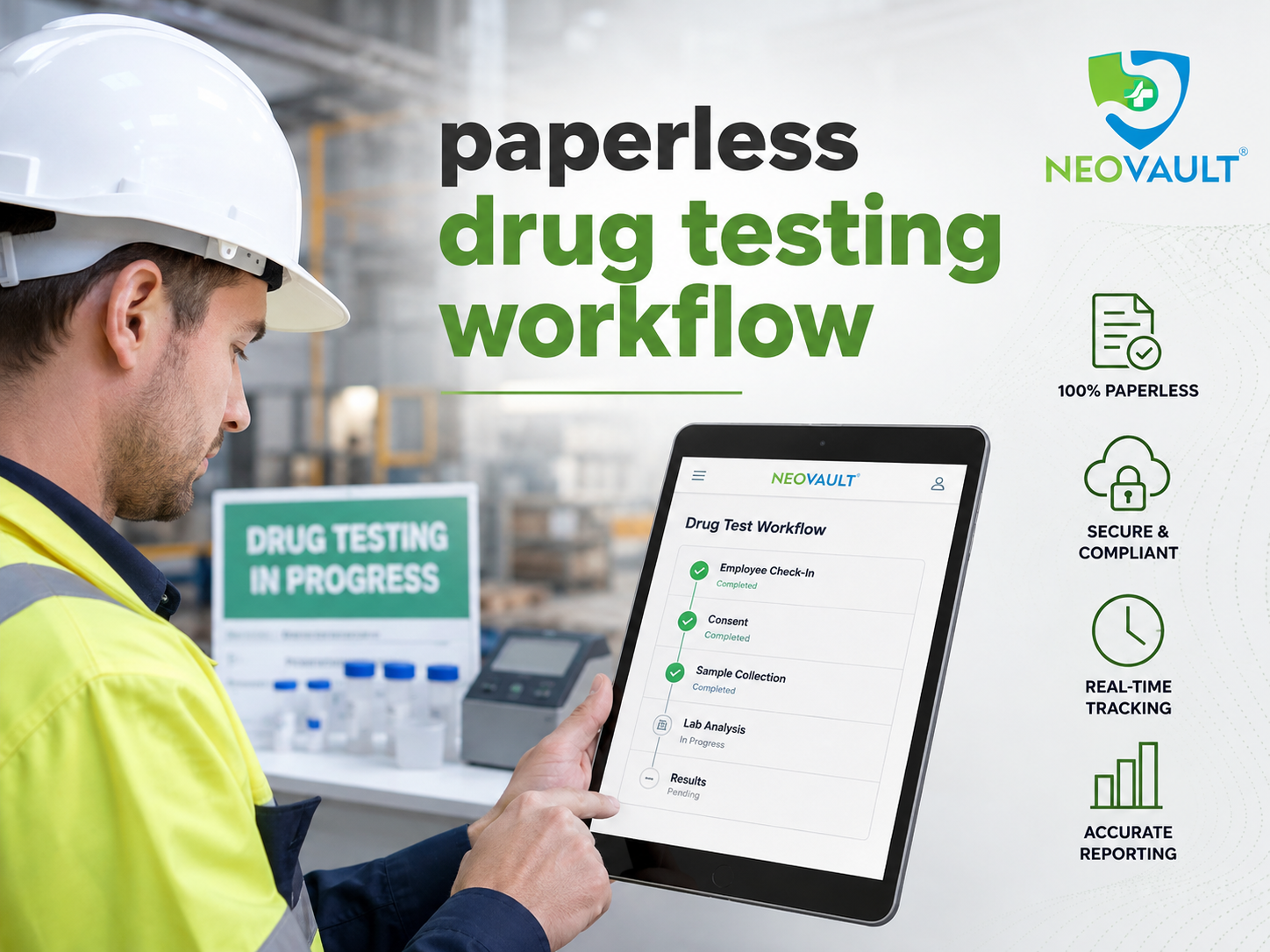
Paperless drug testing workflow for AU compliance
A paperless drug testing workflow replaces traditional physical forms with secure, digital records. By digitising the entire process - from online ordering to automated laboratory reporting - this system improves regulatory compliance, eliminates administrative errors, and ensures pristine data integrity for HR teams.
Historically, workplace substance testing has relied heavily on the standard Custody and Control Form (CCF). This multi-part carbon-copy form is notorious for causing administrative bottlenecks. The electronic Custody and Control Form (eCCF) shifts this paradigm entirely. Instead of physically handing a piece of paper between stakeholders, the eCCF ensures every data point is captured digitally.
The lifecycle of a test within this digital ecosystem operates across several distinct phases. This structured approach ensures that no step is missed during the collection process, protecting both the employer and the employee from procedural disputes.
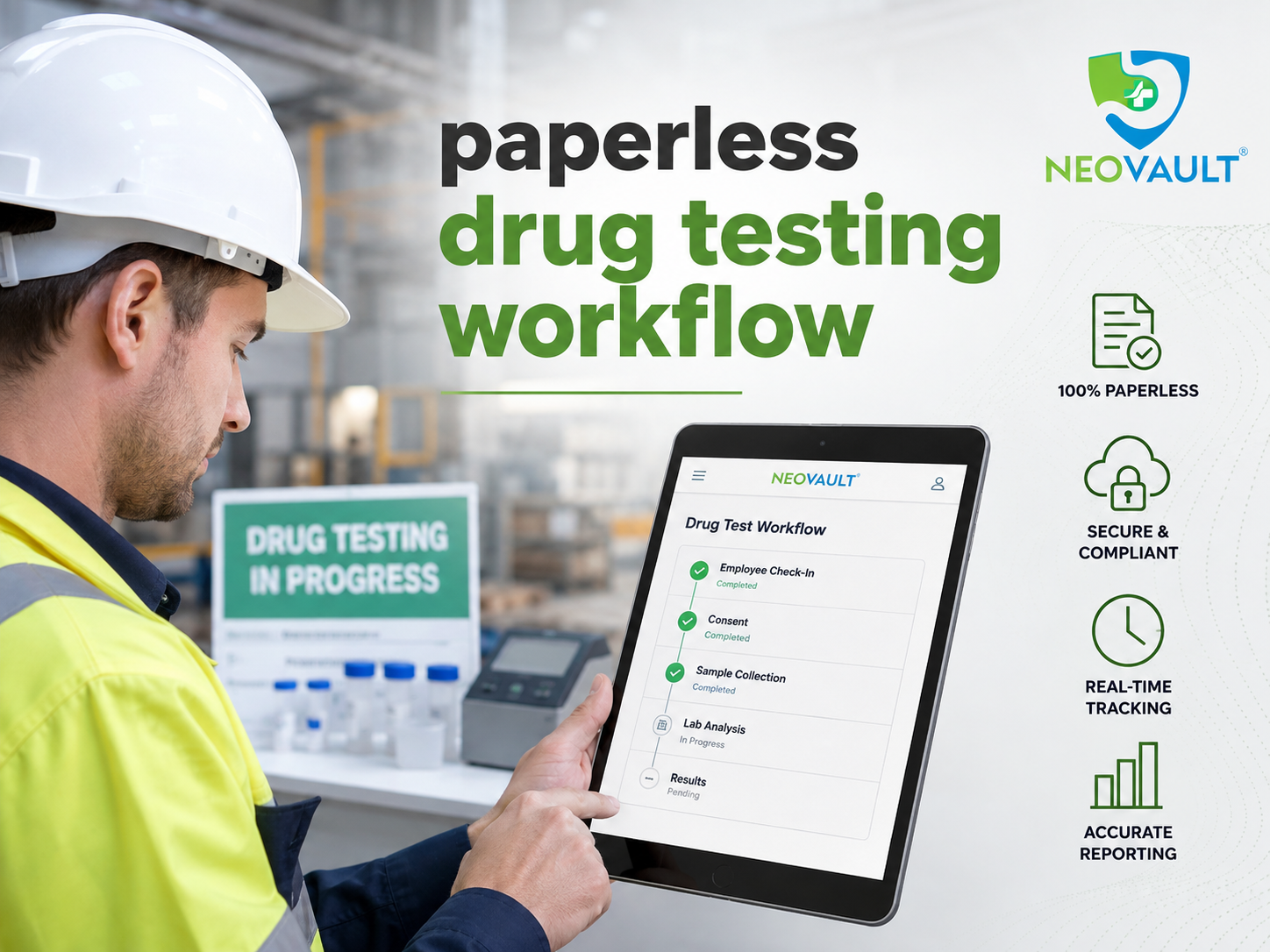
Furthermore, both the donor and the collector provide electronic signatures directly on a tablet interface. Once the specimen is collected and sealed, the electronic record is transmitted instantly. This end-to-end integration makes digital frameworks indispensable for modern safety management in high-risk industries.

Safety manager using a tablet for digital chain of custody in an Australian workplace
Digitising a testing program drastically reduces administrative errors, accelerates turnaround times, and provides robust data security. Replacing illegible handwriting and manual data entry with real-time tracking ensures that highly sensitive employee medical information is securely encrypted and accessible for audits.
When you digitise workplace drug testing, the immediate return on investment becomes apparent through massive reductions in administrative overhead. Traditional paper-based systems are fraught with fatal flaws. A single missed signature or an illegible date can invalidate an entire test. This forces the employer to spend additional money and time re-testing the employee.
Speed is another critical factor for operational continuity. In industries where safety is paramount, keeping an employee off the site while waiting for test results costs the company money. A digital chain of custody eliminates the transit time required for physical paperwork to move between the collection site, the laboratory, and the MRO.
Key advantages of adopting a digital framework include:
To clearly illustrate the operational differences, the following table compares the legacy approach with a modern digital framework:
|
Feature / Process |
Traditional paper-based workflow |
Digital workflow |
|
Data entry & accuracy |
Manual handwriting; high risk of illegible text, missing signatures, and fatal flaws. |
Pre-populated digital fields; system prevents submission if mandatory data is missing. |
|
Chain of custody |
Physical carbon-copy forms that can be easily lost, damaged, or tampered with. |
Secure eCCF with timestamped digital signatures and unbreakable audit trails. |
|
Turnaround time |
Slow; relies on physical courier transport of paperwork between stakeholders. |
Instantaneous; data is transmitted to the lab and MRO in real time upon collection. |
|
Data security |
Low; physical files are vulnerable to unauthorised access and environmental damage. |
High; encrypted cloud storage with strict, role-based user access controls. |
Digital testing frameworks help Australian businesses maintain strict compliance with AS/NZS 4308 for urine testing and AS/NZS 4760 for oral fluid testing. Automated audit trails and timestamped electronic signatures provide documentation that meets the rigorous legal requirements of WHS regulations.
For Australian safety managers, ensuring compliance is a strict legal requirement under the Work Health and Safety (WHS) Act. When a workplace incident occurs, regulatory bodies like Safe Work Australia expect employers to provide immediate evidence that policies were actively enforced. Digital records provide the exact transparency required to withstand intense regulatory scrutiny.
The cornerstone of workplace testing in Australia revolves around two primary standards. AS/NZS 4308 governs the collection and detection of drugs in urine, while AS/NZS 4760 dictates oral fluid protocols. These standards outline rigorous procedures for how a specimen must be collected, sealed, and transported to prevent tampering.
Using compliance software ensures these standards are met seamlessly by:
If an employee challenges a positive test result, the HR manager can instantly export a digitally certified audit trail. This proves the specimen was handled correctly according to AS/NZS guidelines from the moment of collection to the final laboratory analysis. This level of digital defensibility is simply impossible to achieve reliably with paper records.
Mobile applications complement digital testing by offering rapid, data-driven impairment assessments directly in the workplace. Utilising tablet-based screening tools alongside traditional substance testing creates a comprehensive approach to safety management without adding burdensome paperwork to your HR teams.
As the landscape of workplace safety evolves, many forward-thinking Australian organisations are looking beyond traditional substance detection. Safety managers are increasingly focused on the broader concept of impairment, whether caused by fatigue, illness, or residual substance effects. Integrating mobile impairment screening allows companies to proactively assess cognitive and motor function.
Implementing these assessments before an employee begins a high-risk shift acts as an essential preventative measure. In industries like mining and construction, catching impairment early prevents accidents before they occur, drastically reducing liability and worker compensation claims.
Recent academic evaluations highlight the profound efficacy of these digital screening methods. For instance, detailed research on the DRUID tablet application demonstrates that mobile platforms can rapidly and accurately assess user impairment. Studies like this confirm that mobile applications offer an objective, scientific baseline for risk management.
When mobile screening applications are integrated into a broader digital ecosystem, data flows seamlessly into the central HR dashboard. If an employee fails a cognitive tablet test, the system can automatically trigger a formal request for a supervised AS/NZS compliant test. This layered approach ensures proactive risk identification.
Transitioning from a legacy paper system to a fully digitised operation is critical for maintaining WHS compliance. NEOVAULT powers your paperless drug testing workflow by connecting donors, collectors, and HR systems in real time - replacing physical forms with a secure, audit-ready digital ecosystem that eliminates administrative bottlenecks.
For Australian organisations managing complex safety requirements, the NEOVAULT platform provides complete visibility over your entire testing program. Whether managing a remote mining site in Western Australia or a logistics hub in Sydney, safety teams can efficiently enforce fitness-for-work policies through:
Related reading: drug and alcohol register
Yes, an electronic chain of custody is legally compliant in Australia if the platform adheres to relevant WHS regulations and AS/NZS standards. A robust digital system provides a secure, verifiable audit trail that regulators and the Fair Work Commission accept as legitimate evidence of procedural integrity.
Digital workflows protect sensitive employee data by utilising cloud encryption, strict role-based access controls, and secure transmission protocols. Unlike physical paper forms that can be easily misplaced or viewed by unauthorised personnel, digital systems ensure that confidential medical information remains highly secure and private.
No, mobile impairment screening cannot entirely replace traditional drug tests, but it serves as a powerful supplementary tool. Integrated into a digital ecosystem, mobile applications provide immediate risk assessments, helping managers make informed decisions before requiring formal, AS/NZS compliant laboratory testing.
Maintaining a compliant workplace demands absolute accuracy and rigorous documentation. Clinging to outdated, manual processes exposes your organisation to unnecessary administrative errors and severe compliance risks. Transitioning to a paperless drug testing workflow is a strategic necessity to securely track testing data and align with AS/NZS guidelines. Ready to digitise your compliance? Explore the NEOVAULT Drug & Alcohol Testing module and completely automate your safety program today.