-Long-Transparent.png?width=200&height=47&name=NEOVAULT-Sheild-Neo-(R)-Long-Transparent.png)
BLOG
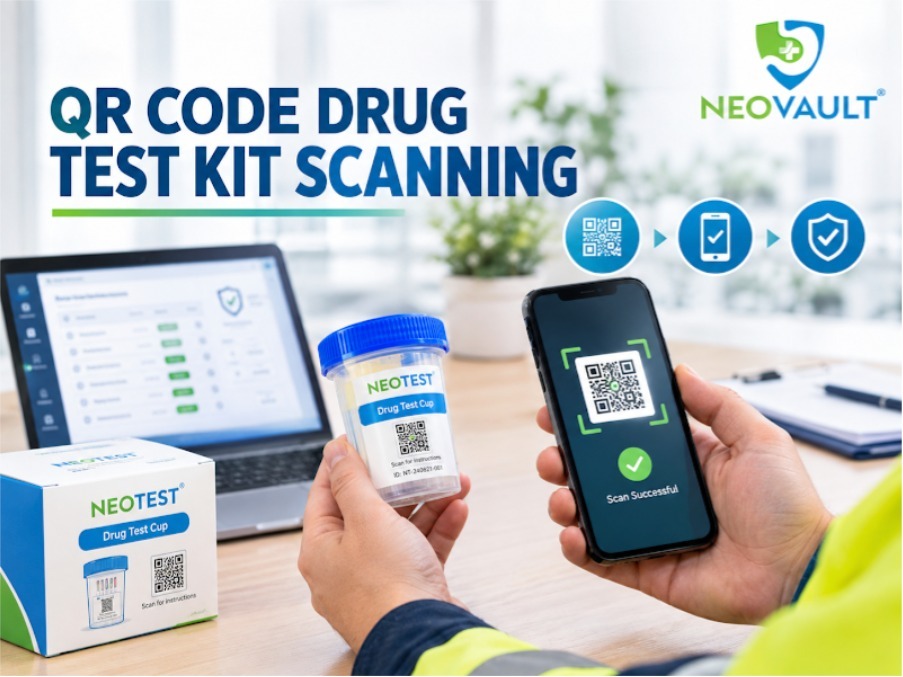

QR code drug test kit scanning means a collector scans a code on the test device with a mobile app. The app reads the result and records who was tested, when and where. It replaces handwritten forms and visual reading of faint test lines. This guide explains how the scan works, what it records, where it stops, and how it fits with laboratory confirmation.
Each kit carries a unique QR code. The collector scans it with an app such as myNEO and photographs the test window. The app interprets the lines and saves the result with a timestamp, a location and the donor details. The record then syncs to a cloud portal for review.
The standard protocol in the field has three steps:
Scanning removes the two weak points of manual testing: subjective reading of results and paper records. A faint line under poor site lighting can start a dispute about a pass or fail. A lost or altered form can break the chain of custody. A scan fixes both at the moment of the test.
Collectors often struggle to read faint lines in dim light, and employers can face wrongful termination claims when a result is disputed. The app compares pixel intensity against set thresholds and returns a negative or non-negative result. Every test is judged the same way, whoever holds the phone.
Paper forms can be forged, misfiled or filled in wrong on the way back to the office. A digital record locks the data when the scan happens. The table below shows the difference.
| Area | Manual paper workflow | QR code scanning |
|---|---|---|
| Data authentication | Handwritten logs that can be altered, with a risk of wrong timestamps or mismatched donor details. | Location, time and electronic signatures are captured automatically. |
| Record storage | Filing cabinets that make older records hard to find. | Encrypted cloud storage with search. |
| Audit readiness | Staff spend days collating documents before an audit. | A full audit trail can be exported when an inspector asks. See our guide to the drug and alcohol testing audit trail. |
Most scanning workflows use oral fluid kits because collection is quick, directly observed and gives a result on site. Oral fluid also points to recent drug use, which matters when the question is whether a worker is impaired now. Published research in the Journal of Analytical Toxicology supports the reliability of oral fluid testing.
No. A rapid kit gives a presumptive result, which means it shows the possible presence of a substance. Any non-negative result must go to a certified laboratory for confirmation before an employer acts on it. Scanning is the fast first filter, and the laboratory gives the final answer.
The laboratory record is the one that matters in a dispute, so keep it linked to the scan. Our guide to audit ready drug testing records covers what to keep and for how long.
NEOVAULT is a secure SaaS platform that digitises workplace impairment testing. With the myNEO mobile app, collectors scan kit codes, capture results and sync them to one dashboard. Reports for audits and multi-site oversight come from the same data.
Before you roll out scanning, check that the system works where your people work, produces records an auditor accepts, and fits kits you already buy. A pilot on one site shows these gaps quickly and costs little.
Treat the first month as a trial. Compare scan results with the collector's own reading, count how many tests need a re-scan, and ask collectors what slowed them down. Our guide to paperless drug testing workflows shows how teams plan that change.
Scanning sits at the point of collection. It does not replace your policy, your training or your laboratory relationship. It improves the quality of the record that those other parts depend on. Pair it with a written policy, trained collectors and a clear rule on who may see results. Once those basics are in place, scanning makes every test faster to record and easier to defend.
Start with one site or one test type, such as random oral fluid tests on a night shift. Measure how long a test takes, how many records are complete on the first attempt and how quickly your team can answer an audit request. Expand once those numbers look better than your paper process.
A digital chain of custody is an electronic record of a sample from collection to final result. It replaces paper forms with digital signatures, timestamps and location data, so any change leaves a visible trace.
You need the app provided by the system developer, such as myNEO. A standard camera app cannot analyse the test lines or encrypt the data to enterprise security standards.
No. A scan gives a rapid presumptive result at the worksite. A non-negative result still goes to a certified laboratory for confirmation.
Moving from paper to QR code drug test kit scanning removes reading errors and gives you a record that stands up to review. Teams that want this workflow can book a live demo of NEOVAULT and the myNEO app with the Neopharma Technologies team.