-Long-Transparent.png?width=200&height=47&name=NEOVAULT-Sheild-Neo-(R)-Long-Transparent.png)
BLOG


Managing workplace risks associated with substance use is a critical challenge for employers across New Zealand. Establishing a robust workplace drug and alcohol policy NZ is essential to comply with the Health and Safety at Work Act 2015. This guide is specifically designed for HR professionals and safety managers navigating these complex legal requirements.
We will explore foundational legal frameworks, outline what a comprehensive document must include, and discuss employee rights. Furthermore, we will examine the modern shift from traditional biological testing methods towards innovative real-time impairment assessment technologies, helping your organisation proactively eliminate operational risks and avoid legal disputes.
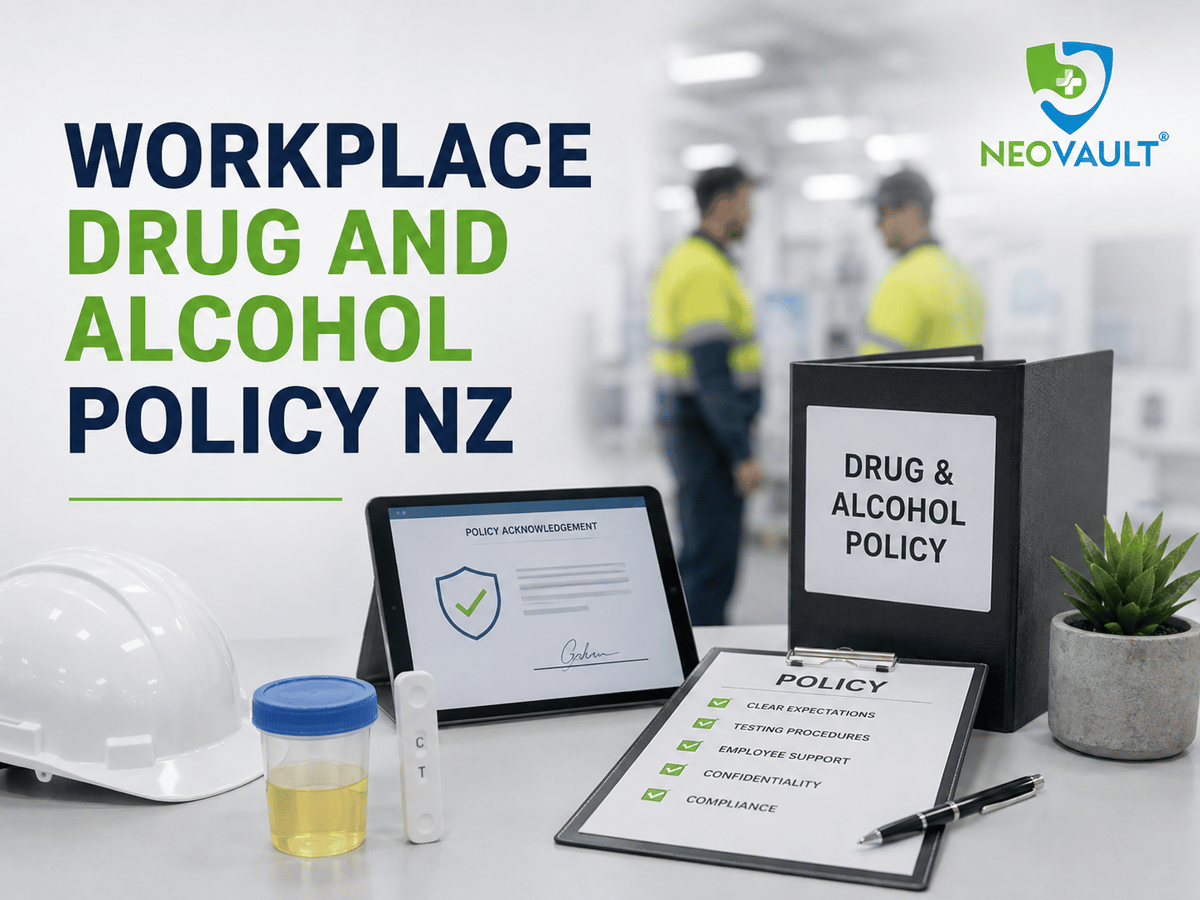
Workplace Drug and Alcohol Policy NZ Guide
In New Zealand, while no specific law mandates drug testing, the Health and Safety at Work Act 2015 requires employers to proactively manage workplace risks. A compliant policy ensures workplace safety while strictly adhering to the Privacy Act 2020 and established employment agreements.
Under the HSWA 2015, businesses have a primary duty of care to ensure the health and safety of their workers. Implementing a clear workplace drug and alcohol policy NZ is a fundamental step in fulfilling these legal duties. To proactively manage these risks, employers must:
When developing your procedures, you must carefully balance safety obligations with the privacy rights of your workforce. The Privacy Act 2020 dictates that collecting biological data through drug testing in the workplace must be reasonable, secure, and directly relevant to safety outcomes. To maintain legal compliance, your approach must ensure:
A compliant drug and alcohol framework must clearly define its scope, acceptable behaviours, and exact testing procedures if implemented. Furthermore, it should thoroughly outline disciplinary consequences alongside providing robust support mechanisms, such as employee assistance programmes, ultimately fostering a positive, safety-first company culture.
Your policy document must explicitly state who is covered, including contractors and temporary staff, applying consistently across the organisation. It should clearly define what constitutes acceptable and unacceptable behaviour regarding substance use during work hours, on company premises, or while operating company vehicles.
If your organisation decides to implement testing, the policy must transparently detail the exact circumstances under which testing will occur. These procedures must be entirely fair, scientifically reliable, and typically include:
Additionally, the document must outline exact consequences for breaches, including the disciplinary process, potential suspension, and steps required for a safe return to work.
A modern safety culture focuses on rehabilitation rather than relying solely on punitive measures. Your policy should detail the support systems available for employees struggling with substance dependency, providing access to confidential counselling services and demonstrating a genuine commitment to worker wellbeing.
Traditional biological testing often detects past substance use rather than current cognitive impairment, leading to complex legal disputes in NZ. Transitioning to real-time impairment assessment technologies focuses directly on immediate workplace readiness, aligning perfectly with safety goals of eliminating active operational risks.
Standard urine tests often detect traces of substances, such as THC, weeks after initial use rather than indicating current impairment. This reliance on historical biological testing exposes companies to unnecessary legal vulnerabilities and creates several significant challenges:
To overcome biological screening limitations, forward-thinking companies are adopting technology that measures actual cognitive function. A recent study on real time impairment testing using the DRUID app shows this technology tracks blood alcohol concentration closely and has an 82% concordance with Drug Recognition Experts. Integrating these assessments directly addresses safety mandates by:
To implement your framework effectively, embed the terms directly into all employment agreements and ensure thorough consultation with unions or staff. Additionally, conduct regular training for managers to recognize signs of impairment objectively and consistently apply the documented safety rules.
Under New Zealand employment law, a workplace drug and alcohol policy NZ cannot be unilaterally imposed without proper consultation. You must engage with your workforce and union representatives to ensure the policy is viewed as a supportive safety measure. Key implementation steps include:

Updating Employment Agreements Guide
A written document is useless if it is not understood and enforced correctly. Managers require specialized training to identify physical and behavioural signs of impairment objectively. This ensures any request for testing based on reasonable cause is justified and not driven by personal bias.
Translating a written workplace drug and alcohol policy NZ into daily operational practice can expose organisations to significant administrative risks. The NEOVAULT platform provides a secure SaaS solution featuring the Impairment Risk Management (IRM) module to digitise your entire fitness for work programme, ensuring strict compliance with the Privacy Act 2020 and the HSWA 2015.
|
Policy Enforcement Challenge |
The NEOVAULT Digital Solution |
|
Manual Record Keeping: Paper-based forms risk breaching employee privacy and easily get lost during internal audits. |
Centralised Digital Hub: Securely stores all testing outcomes in a single, enterprise-ready cloud platform. |
|
Subjective Assessments: Managers struggle to prove "reasonable cause" objectively, frequently leading to ERA disputes. |
Cognitive Assessment: Utilises 1-minute real-time cognitive tests to measure actual impairment, rather than historical substance use. |
|
Inconsistent Testing: Random testing schedules are often missed or inadvertently biased on busy sites. |
Automated Workflows: Automatically flags staff for random or mandatory post-incident testing based on your specific site rules. |
By leveraging this digital infrastructure, HR professionals and safety managers can proactively eliminate active operational hazards. Every managerial action is captured in a time-stamped audit trail, transforming complex administrative duties into a streamlined, defensible safety protocol that protects both the business and its workforce.
Related reading: workplace drug testing in NZ, AS/NZS 4308
No. Employers cannot physically force an employee to undergo a test. However, if testing is a documented condition of the employment agreement and the employee refuses, this refusal can generally be treated as a serious breach of policy, potentially leading to disciplinary action.
No. A positive urine test for THC indicates past use, which could have occurred weeks prior, rather than active cognitive impairment. This discrepancy is a primary cause of legal disputes, highlighting the urgent need for real-time cognitive testing solutions.
Yes. Random drug testing is generally legal and justifiable for specific safety-sensitive roles, such as operating heavy machinery or driving commercial vehicles. In these environments, the significant risk of harm outweighs the individual's right to privacy, provided the policy is communicated clearly.
Managers should follow the documented procedures in the company policy immediately. This usually involves removing the employee from any safety-sensitive tasks, conducting a private conversation to discuss the observed signs of impairment, and arranging for an objective assessment if reasonable cause is established.
Maintaining a robust workplace drug and alcohol policy NZ is about much more than just ticking boxes for legal compliance; it is about fundamentally protecting your people. By systematically shifting away from risky biological testing and embracing innovative real-time cognitive assessments, your business can effectively eliminate active operational hazards. This proactive approach ensures you respect employee privacy rights, maintain a supportive company culture, and successfully avoid costly employment disputes while fulfilling your core health and safety obligations.