-Long-Transparent.png?width=200&height=47&name=NEOVAULT-Sheild-Neo-(R)-Long-Transparent.png)
BLOG

Maintaining a safe working environment is a fundamental legal duty for businesses in New Zealand. However, understanding the fine line between safety and privacy rights can be challenging. Implementing workplace drug testing NZ requires careful planning to ensure policies are effective and legally robust.
This guide provides an overview of employee drug testing laws NZ, the relevant AS/NZS standards, and best practices for creating a comprehensive drug and alcohol policy NZ. Whether navigating the Health and Safety at Work Act 2015 or modernising compliance with workplace impairment testing NZ, we break down the essential steps for your organisation.
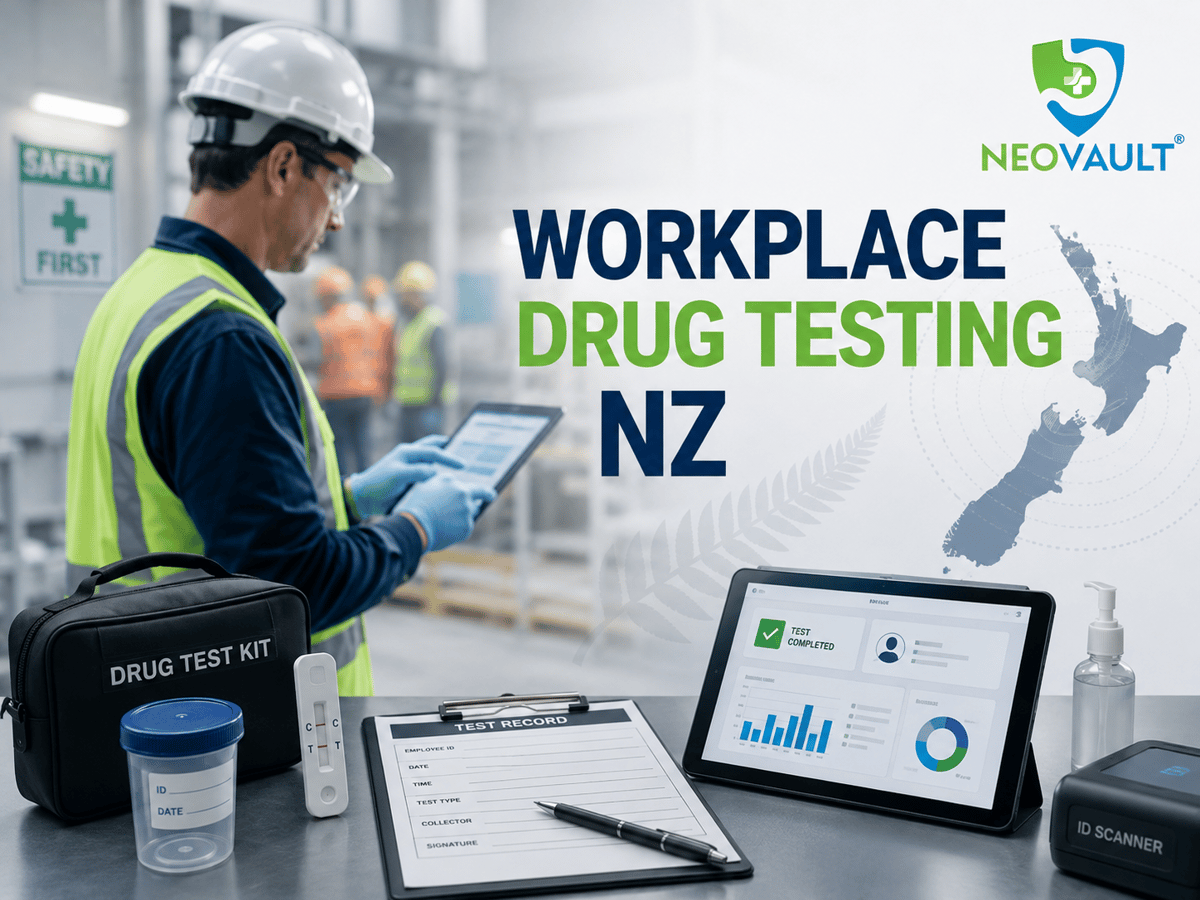 Workplace Drug Testing NZ Complete Guide
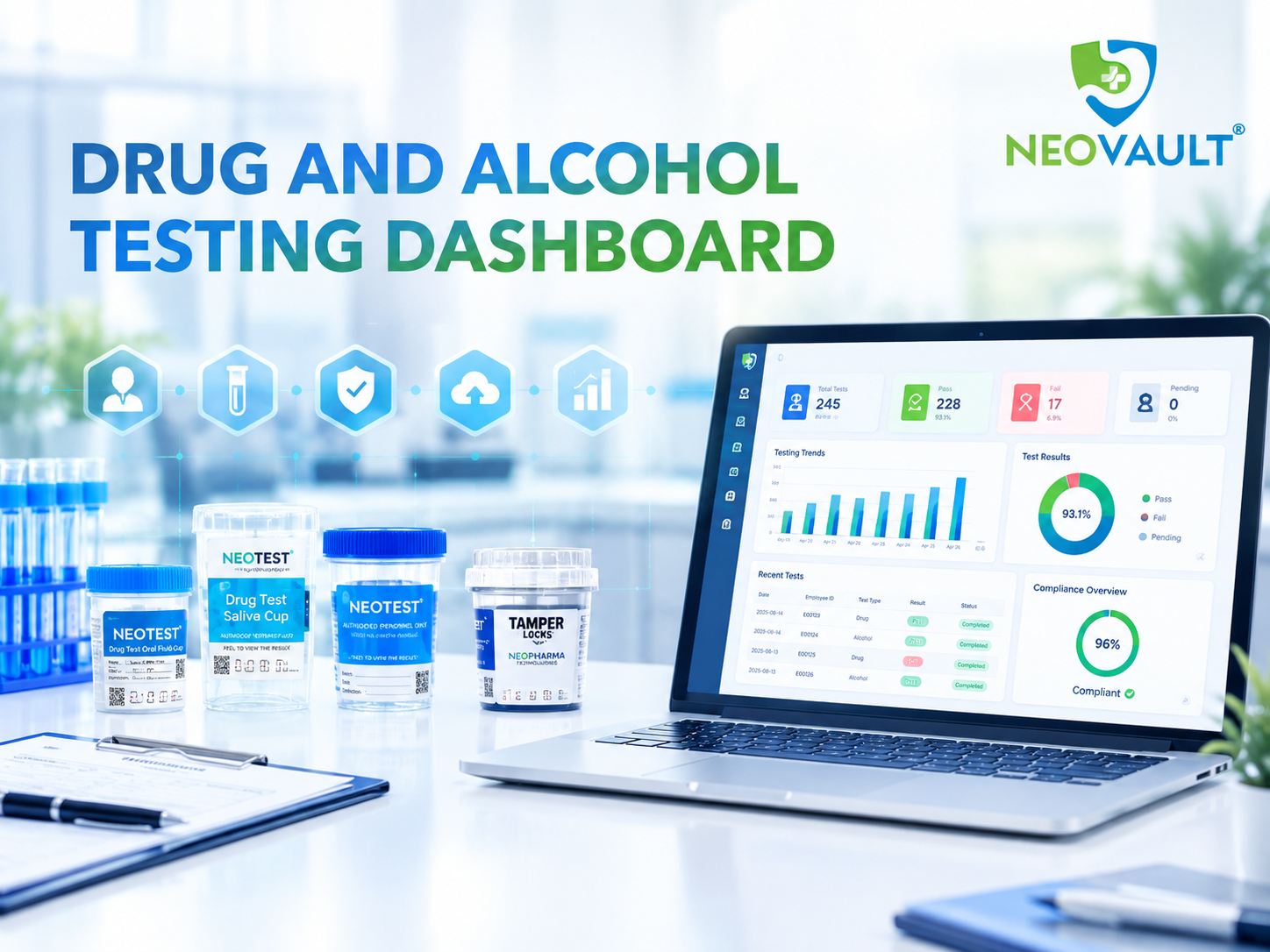
Dashboard for managing workplace drug testing in NZ and tracking compliance KPIs
Workplace drug testing is legal in New Zealand if strictly documented in an employment agreement and a clear company policy. Under the Health and Safety at Work Act 2015 (HSWA), employers must ensure a safe environment, making testing reasonable when balancing safety against employee privacy.
In New Zealand, no single legislation explicitly dictates testing protocols. Instead, the Health and Safety at Work Act 2015 places a primary duty of care on employers (PCBU) to ensure worker safety. If substances pose a genuine safety risk, testing becomes a reasonably practicable mitigation step. For high-risk sectors like construction, mining, and transport, managing these hazards is non-negotiable. Employers must assess their specific operational risks to determine if testing is a necessary control measure to prevent serious harm.
While safety is critical, employers must also navigate the Privacy Act 2020. Drug testing is intrusive; thus, it must be justified, proportionate, and conducted fairly. To maintain compliance, organisations must ensure:
New Zealand workplaces typically follow two main testing standards for legally defensible results. AS/NZS 4308 covers urine drug testing protocols, while AS/NZS 4760 outlines the procedures for oral fluid (saliva) testing, ensuring accuracy and a proper chain of custody.
Urine testing has historically been the most common method. The AS/NZS 4308 standard dictates rigorous procedures for specimen collection and laboratory analysis. While highly effective at detecting past drug use (metabolites remain for days or weeks), it detects historical use rather than active impairment. Despite this limitation, it remains a robust method for pre-employment screening.
Governed by AS/NZS 4760, oral fluid testing has gained significant traction. This method detects the active presence of a drug, offering a shorter detection window (12 to 24 hours). This makes it a better indicator of recent use and potential active impairment. Safety managers often prefer it because the collection is less invasive.
|
Testing Method |
Applicable Standard |
Detection Window |
Primary Use Case |
|
Urine Testing |
AS/NZS 4308 |
Days to weeks (historical use) |
Pre-employment screening |
|
Oral Fluid (Saliva) |
AS/NZS 4760 |
12 to 24 hours (recent use) |
Post-incident, random testing |
Employers in NZ can conduct drug tests under specific circumstances defined in their policy. These typically include pre-employment screening, random testing for safety-sensitive roles, post-incident testing after accidents, and reasonable cause testing when impairment is suspected.
Testing applicants before they join is standard practice to filter out safety risks. This must be communicated during recruitment, with employment offers made conditional upon a negative result. Random testing is heavily scrutinised and generally only lawful for employees in safety-sensitive roles—positions where impairment could lead to serious injury. To serve as an effective deterrent, random testing must be:
When a safety breach occurs, post-incident testing helps determine if drugs or alcohol were contributing factors. This is a critical step in incident investigations to prevent future occurrences. Reasonable cause testing is conducted when a supervisor suspects an employee is impaired on duty. Managers must be adequately trained to:
The rise of prescribed medical cannabis requires NZ employers to shift from strict presence-testing to impairment risk management. Recent studies show prescribed cannabis users may not experience acute cognitive impairment, encouraging companies to adopt flexible, impairment-focused policies rather than immediate termination.
The increasing use of prescribed medical cannabis has fundamentally changed how HR professionals approach drug policies. Traditional urine tests only indicate the presence of a substance, not whether an employee is actively impaired. A positive test for THC could mean the employee used legally prescribed medication days ago. Terminating an employee solely based on presence exposes companies to severe legal risks, including unfair dismissal claims.
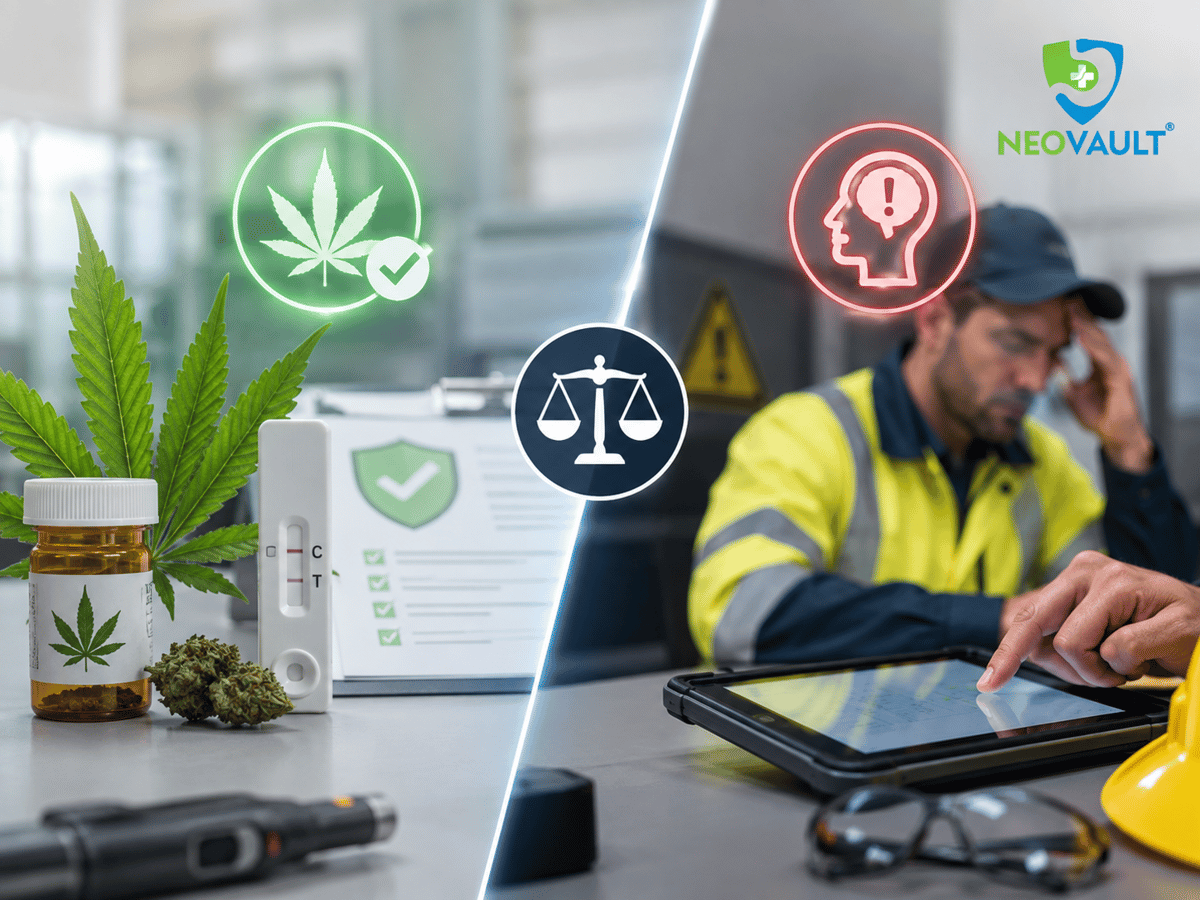
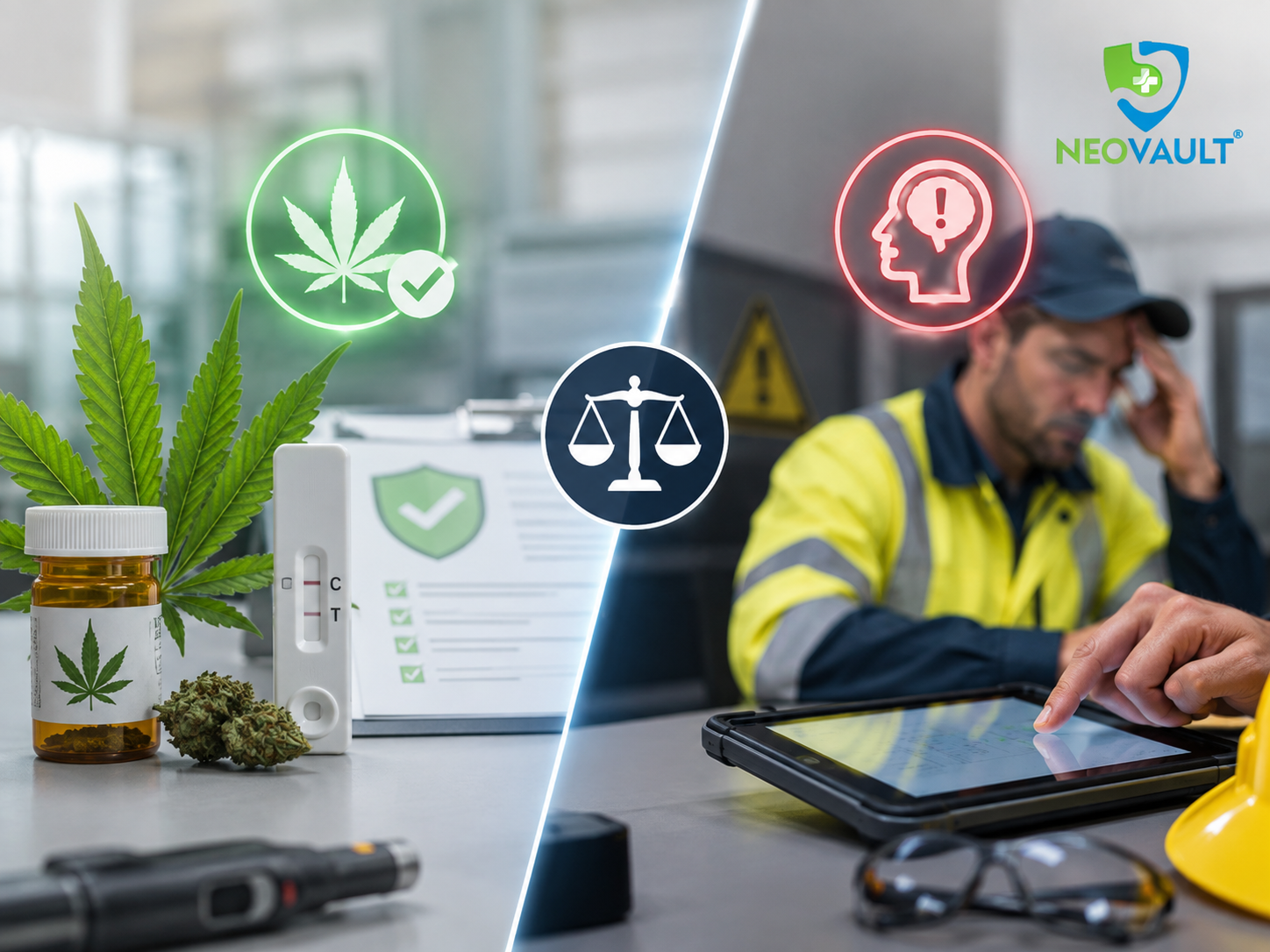
Substance Presence vs Active Impairment
Forward-thinking organisations are focusing on cognitive capability rather than penalising presence. Evidence supports this shift; recent research on prescribed medical cannabis highlights that patients may not experience acute cognitive impairment compromising their work ability.
Instead of enforcing rigid zero-tolerance policies resulting in immediate dismissal, companies are encouraged to adopt nuanced approaches. Flexible risk assessments evaluating actual fitness for duty help maintain high safety standards while respecting legitimate medical treatments.
As the conversation shifts from detecting simple substance presence to proactively managing actual workforce capability, relying on manual spreadsheets and paper records creates severe legal vulnerabilities. Digitising your workplace drug testing NZ programme is now a critical step for maintaining defensible safety standards.
The NEOVAULT platform provides a secure, enterprise-ready SaaS solution to centralise your safety operations. Here is how modernising your approach eliminates administrative burdens and directly addresses the requirements of the HSWA 2015:
|
Compliance Challenge |
The NEOVAULT Digital Solution |
|
Paper-Based Chain of Custody: Physical forms are prone to data entry errors and easily lost, threatening the integrity of test results. |
myNEO Mobile App: Collectors scan QR codes and capture digital signatures on-site, establishing an unbroken, tamper-proof electronic record from site to lab. |
|
Presence vs. Impairment: Traditional urine tests only indicate historical use, not if an employee is actively impaired today. |
Impairment Risk Management (IRM): Integrates 1-minute cognitive assessments to measure real-time readiness, protecting businesses from unfair dismissal claims related to medical cannabis. |
|
Manual Compliance Tracking: Supervisors struggle to track randomised testing schedules manually across multiple operational sites. |
Automated Workflows & Reporting: Automatically triggers unbiased random tests and generates time-stamped, audit-ready reports on a unified dashboard. |
By transitioning to this comprehensive digital infrastructure, safety managers can securely store sensitive health data and ensure their testing procedures are legally robust, fair, and fully aligned with modern employment agreements.
Yes, employee consent is required before any test is administered. However, if testing is a documented condition of their employment agreement and they refuse without a reasonable excuse, they may face disciplinary action based on established policy.
It depends on the specific policy and circumstances. Employers must follow a fair disciplinary process. With the rise of medical cannabis, immediate termination is generally discouraged; impairment risk assessments and rehabilitation options are often recommended instead.
Yes, breath testing is the standard method for detecting alcohol impairment in the workplace. To ensure legally defensible results, the device used must meet the AS 3547 standard, and the procedure must be clearly outlined in the organisation's policy.
Navigating workplace drug testing NZ requires understanding the Health and Safety at Work Act, adhering to AS/NZS standards, and adopting a modern approach to impairment. As medical cannabis usage grows, organisations must shift from detecting substances to proactively managing actual cognitive capability. To streamline compliance and protect your business, transitioning to a digital solution is essential. NEOVAULT provides a secure SaaS platform that digitises your testing workflow, ensures a verifiable chain of custody, and delivers real-time risk insights.