BLOG
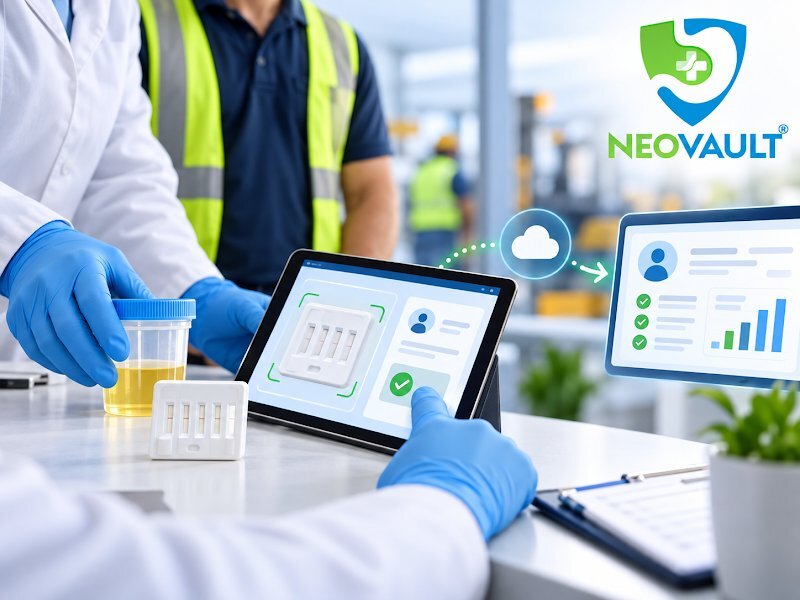

A drug test reporting platform connects workplace testing with traceable digital records. NEOVAULT helps safety managers, HR teams and testing providers capture collection information, track chain of custody and access centralised reports without scattered paperwork. Developed by Neopharma Technologies Limited, NEOVAULT connects physical test kits with mobile capture, review and reporting workflows. This article follows the path from kit identification to digital reporting, explains reporting essentials, and outlines considerations for Australian and US employers managing drug and alcohol testing programmes.
A drug test reporting platform organises workplace testing data into traceable electronic records. It links test details, screening outcomes, review and reporting access. Instead of reconstructing events from paper forms, authorised teams can follow the testing lifecycle and locate the supporting information when operational or audit questions arise.
These components serve different purposes within a workplace drug and alcohol testing program:
The main users include:
Neopharma Technologies Limited approaches test-to-report digitisation through NEOVAULT: registering the test and kit, capturing collection details via myNEO, preserving digital chain of custody, and making reviewed records available through Reporting & Analytics. Each stage connects physical testing to traceable digital records while supporting the appropriate review and confirmation processes.
Neopharma's approach begins by connecting each physical testing event to a digital identity within NEOVAULT. The record captures essential information before or during collection:
NEOVAULT supports a device-agnostic approach to digital testing. NEOTEST products are designed to integrate with the platform, while other compatible point-of-care devices can also be enabled. This gives employers flexibility when connecting physical testing with digital reporting.
The next stage uses the myNEO mobile app to capture testing information at the point of collection. This mobile-first workflow is a key part of Neopharma's approach to reducing manual data entry:
By recording information during collection, NEOVAULT helps reduce reliance on handwritten forms and subsequent transcription. Data captured offline becomes available for central reporting after successful synchronisation.
Once collection details and screening results are recorded, NEOVAULT's Drug & Alcohol Testing module supports digital chain-of-custody tracking and result management. The workflow helps authorised teams maintain traceability through:
A non-negative screening result does not automatically establish a confirmed positive finding. Laboratory confirmation or authorised review may still be required under the applicable testing procedure. NEOVAULT supports documentation of these stages without replacing the required professional decisions.
The final stage brings recorded testing information into NEOVAULT's Reporting & Analytics module. Neopharma's approach connects field-level records with centralised reporting so authorised teams can access relevant information across workplace locations:
The result is a connected workflow from physical kit identification to digital reporting. NEOVAULT brings together myNEO, Drug & Alcohol Testing and Reporting & Analytics to help businesses manage testing information consistently across their operations.
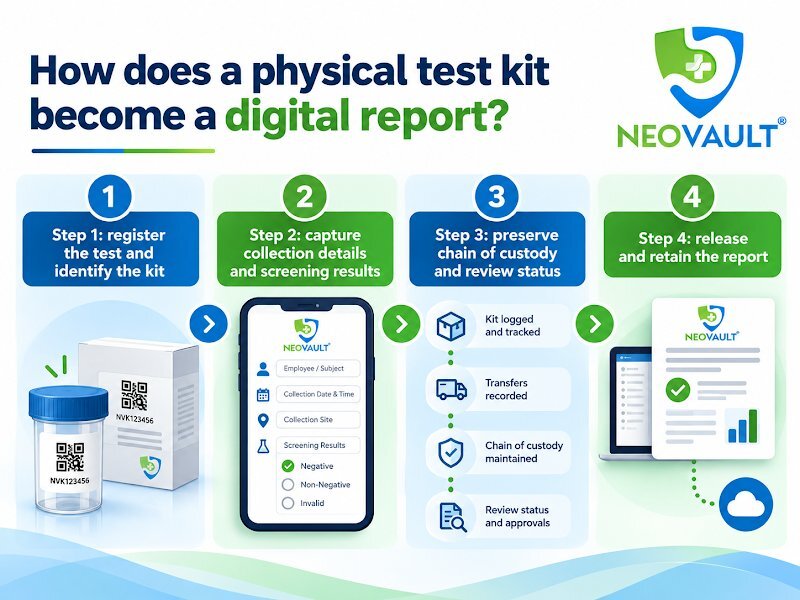
Four-step workflow from physical test kit to digital report
A useful digital drug test report shows more than a screening outcome. It links the result to the test event, collection conditions, relevant personnel and review status. Fields depend on policy and applicable requirements. It should also show whether follow-up is required before release.
The following is an illustrative reporting structure, not a prescribed regulatory form:
| Field group | Example information | Purpose |
|---|---|---|
| Test identity | Worker ID, site, reason, kit code | Connects a result to the correct event |
| Collection | Collector, test type, date and time | Establishes collection context |
| Result status | Screening outcome, pending review, final status | Prevents preliminary and final outcomes being confused |
| Record history | Actions, timestamps, authorised reviewer | Supports traceability and oversight |
Audit-ready drug testing reports rely on the record surrounding the result. Teams should be able to establish:
NEOVAULT's digital chain of custody is designed to connect these activities to a traceable testing record.
Choosing drug and alcohol testing software requires more than inspecting a dashboard. Buyers should test how the system works at remote sites, who can approve or view information, and what happens when a record needs correction or follow-up. An effective drug testing reporting dashboard is useful only when the underlying data is complete and properly controlled.
For workplace drug test reporting across dispersed workforces, check:
Ask vendors to demonstrate incomplete records and exceptions:
| Evaluation area | Paper or spreadsheet approach | Digital reporting platform |
|---|---|---|
| Result entry | Re-entry from handwritten notes | Structured collection-stage capture |
| Record retrieval | Search emails and files | Search linked electronic records |
| Custody history | Separate forms and signatures | Linked events and timestamps |
| Multi-site reporting | Periodic manual consolidation | Centralised reporting views |
| Access control | Dependent on file-sharing practice | Defined roles and permissions |
Neopharma Technologies Limited's approach connects physical workplace testing with traceable digital records through NEOVAULT. The workflow links kit identification, myNEO mobile data capture, digital chain of custody and centralised reporting. This helps businesses manage testing information from collection to authorised review while maintaining the distinction between screening results and final outcomes.
The mobile component focuses on information gathered during testing:
The module supports operational control across common testing scenarios:
Confirmation still requires authorised review.
The reporting layer supports:
Explore the NEOVAULT platform to see how these collection and reporting components work together.
NEOVAULT also supports Impairment Risk Management (IRM), including a separate cognitive and psychomotor screening pathway. This can add context to broader workforce risk management, but the distinction matters:
Neither should be presented as a stand-alone medical diagnosis.
Australia and the United States apply different frameworks to workplace drug testing. Employers must assess the rules governing their specific workforce, testing method and industry before adopting electronic records. A platform can support consistent documentation, but digital records do not automatically meet every applicable collection, privacy or reporting requirement.
Safe Work Australia explains that businesses must manage work health and safety risks, which may include drug and alcohol policies. Practical considerations include:
DOT-regulated programs have additional conditions. The US DOT eCCF guidance explains that a specific electronic Federal Custody and Control Form can be used only when the employer's laboratory has the required approval and the employer elects to use it.
A drug test reporting platform supports physical testing; it does not replace test kits or required confirmation. It can capture records offline and maintain reporting history, but DOT-regulated programs have specific electronic form rules. The answers below clarify these boundaries and explain how businesses should handle preliminary screening results.
No. A drug test reporting platform stores and manages information generated by workplace testing. Physical collection, screening devices, laboratory confirmation and professional review remain necessary wherever the testing method or program requires them. The software helps authorised people track the process and retrieve records; it does not perform the clinical or analytical work of a laboratory.
No. Digital chain of custody describes electronic tracking of test-related actions. DOT eCCF is a specific federal document workflow subject to additional requirements, including laboratory approval and an employer's decision to adopt the approved system. Employers should verify the complete collection pathway rather than assume that any electronic form is acceptable for DOT-regulated tests.
Yes. Collectors can record tests without internet access when the mobile application supports offline capture. The myNEO workflow includes this option and synchronises information after connectivity returns. Employers should check how the selected configuration handles pending uploads, duplicate records and access restrictions. A disconnected device cannot provide an instantly updated central dashboard.
Non-negative screening results should appear as preliminary or pending follow-up, not as confirmed positives. The reporting workflow should retain the initial observation, subsequent confirmation or review status, and final authorised outcome. This distinction helps prevent inappropriate decisions based on an initial screen. The exact steps depend on the testing method and applicable rules.
A drug test reporting platform should make workplace testing records easier to capture, review and trace. NEOVAULT connects physical test kits with mobile collection, digital chain of custody and centralized reporting, giving safety managers and testing providers a clearer view across sites. Its structured workflows support consistent documentation while leaving confirmation and authorised decisions to the appropriate people. Explore the NEOVAULT platform and request a demonstration to assess how its reporting capabilities fit your organisation's testing policy and operational needs.