-Long-Transparent.png?width=200&height=47&name=NEOVAULT-Sheild-Neo-(R)-Long-Transparent.png)
Industry News

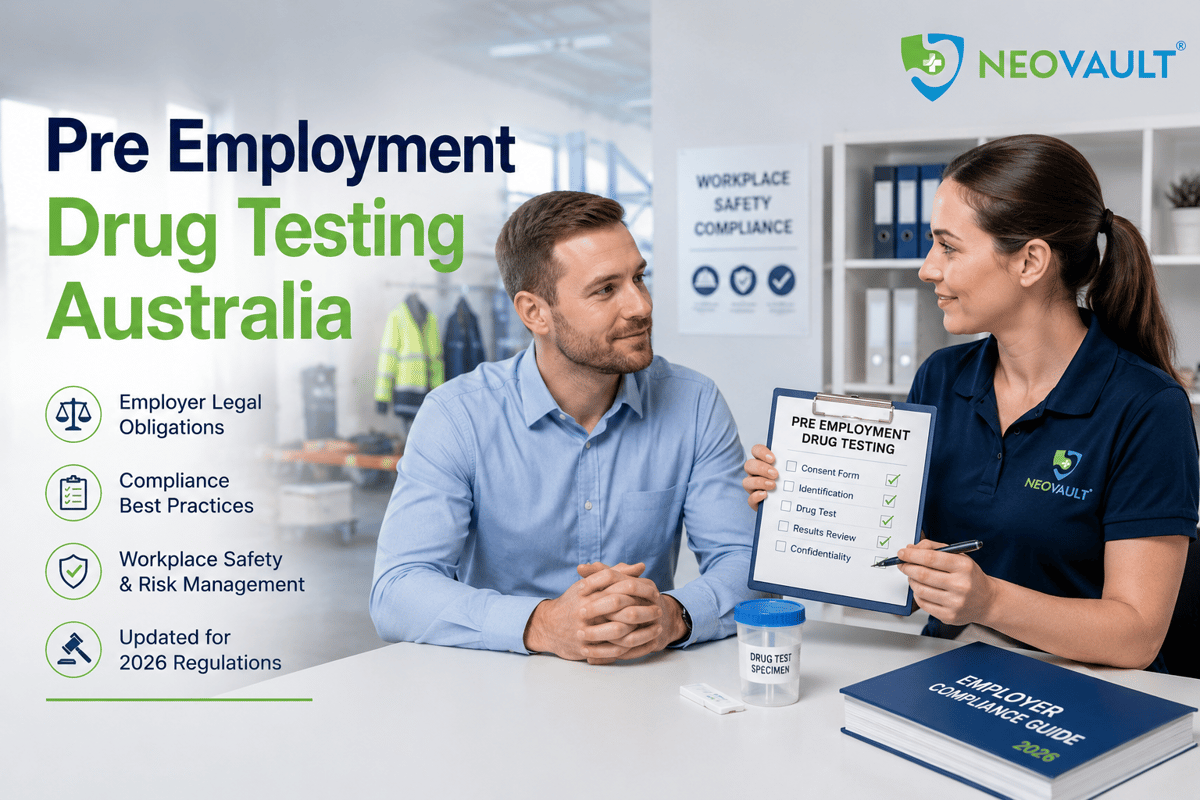
Implementing a compliant pre employment drug testing australia program is critical for businesses in high-risk sectors like mining, construction, transport, and manufacturing. Under Australian Work Health and Safety (WHS) laws, employers have a strict duty of care to ensure a safe, impairment-free environment. Screening candidates before they enter a safety-sensitive site is an effective risk prevention tool.
However, establishing this process requires careful navigation of privacy regulations, candidate consent, and strict adherence to AS/NZS 4308 and AS/NZS 4760 standards. As compliance grows more complex, replacing paperwork with digital workflows is essential. This guide provides HR and safety managers with a complete framework to build a legally defensible testing process.
Pre Employment Drug Testing Australia: Legal & Compliance Guide
Pre-employment drug testing is legal in Australia when justified by Work Health and Safety (WHS) obligations. Employers must balance their duty of care to provide a safe workplace with candidate consent, fair work regulations, and privacy standards for all safety-sensitive roles.
According to the Safe Work Australia Drugs and Alcohol Hazard Management guidelines, Persons Conducting a Business or Undertaking (PCBUs) have a primary duty to eliminate or minimise risks to health and safety so far as is reasonably practicable. When navigating pre employment drug test laws australia, employers should focus on the following key duties:
While safety is paramount, employers must respect candidate rights throughout the recruitment phase. A legally sound testing program relies on transparent communication and the following core principles:
When evaluating the saliva vs urine pre employment drug test debate for Australian screening, urine testing offers a longer detection window under AS/NZS 4308. In contrast, oral fluid screening under AS/NZS 4760 measures recent impairment, allows rapid on-site collection, and is generally considered less invasive for candidates.
Choosing the right testing matrix depends heavily on your industry requirements and specific risk profile. Below is a comparison to help HR and Safety Managers select the appropriate method.
|
Criteria |
Urine Testing (AS/NZS 4308) |
Oral Fluid / Saliva Testing (AS/NZS 4760) |
|
Detection Window |
Longer (Typically 2 to 5 days, depending on the substance) |
Shorter (Usually detects use within the last 12 to 24 hours) |
|
Primary Focus |
Historical use and lifestyle habits |
Recent use and immediate impairment risks |
|
Invasiveness |
High (Requires a secure, private bathroom facility) |
Low (Can be collected openly in any clean room) |
|
Adulteration Risk |
Moderate (Candidates may attempt to substitute or dilute samples) |
Very Low (Sample is collected under direct observation) |
For organizations requiring a comprehensive overview of a candidate's recent substance history, urine screening remains the industry standard. To ensure results are legally defensible, the AS/NZS 4308 pre employment drug testing framework dictates several strict requirements:
Oral fluid testing is becoming increasingly popular for pre-employment checks due to its ease of administration. Guided by the updated Standards Australia AS/NZS 4760:2019, this method is highly effective for:
Building a legally defensible policy for pre employment drug testing australia requires explicit documentation. Your policy must clearly outline the testing scope, candidate consent mechanisms, medical declarations, and establish clear, consistent procedures for handling prescription medications and non-negative results to avoid discrimination claims.
Consistency is the foundation of a defensible procedure. Applying rules arbitrarily across different candidates opens the door to legal disputes. A robust pre employment drug screening policy should clearly define:
A positive screen does not always mean illegal drug use; many prescription medicines contain substances that trigger screening devices. Your workflow must include a formal declaration step where candidates can disclose prescribed treatments. If an initial screen flags a substance, the role of a qualified Medical Review Officer (MRO) includes:
The Australian pre-employment drug testing workflow follows a strict sequence to ensure accuracy and fairness. This process ranges from candidate notification and chain of custody tracking during initial on-site screening, to secure sample sealing and accredited laboratory confirmatory testing for any non-negative results.
To maintain audit readiness, employers should enforce the following structured process:
The integrity of the physical sample and the associated documentation is critical. Even a minor clerical error on a paper form can invalidate a test. Maintaining sample integrity involves:
It is crucial to understand that an initial screening device does not yield a "positive" result; it returns a "non-negative", indicating the presence of a substance class above the threshold. To ensure strict compliance, the non-negative pre employment drug test process involves:
Handling "Non-Negative" Results & Laboratory Confirmation
NEOVAULT digitises pre-employment drug screening by completely eliminating paper forms through a digital chain of custody. By using the mobile myNEO app for sample collection, HR managers gain real-time risk alerts and seamless integration with fit-for-duty impairment risk management workflows across multiple sites.
Relying on manual paper forms for pre-employment testing leads to lost documents, illegible handwriting, and significant compliance risks. Transitioning to a digital chain of custody pre employment screening process resolves these issues completely. By utilizing the myNEO collector app, testing officers can:
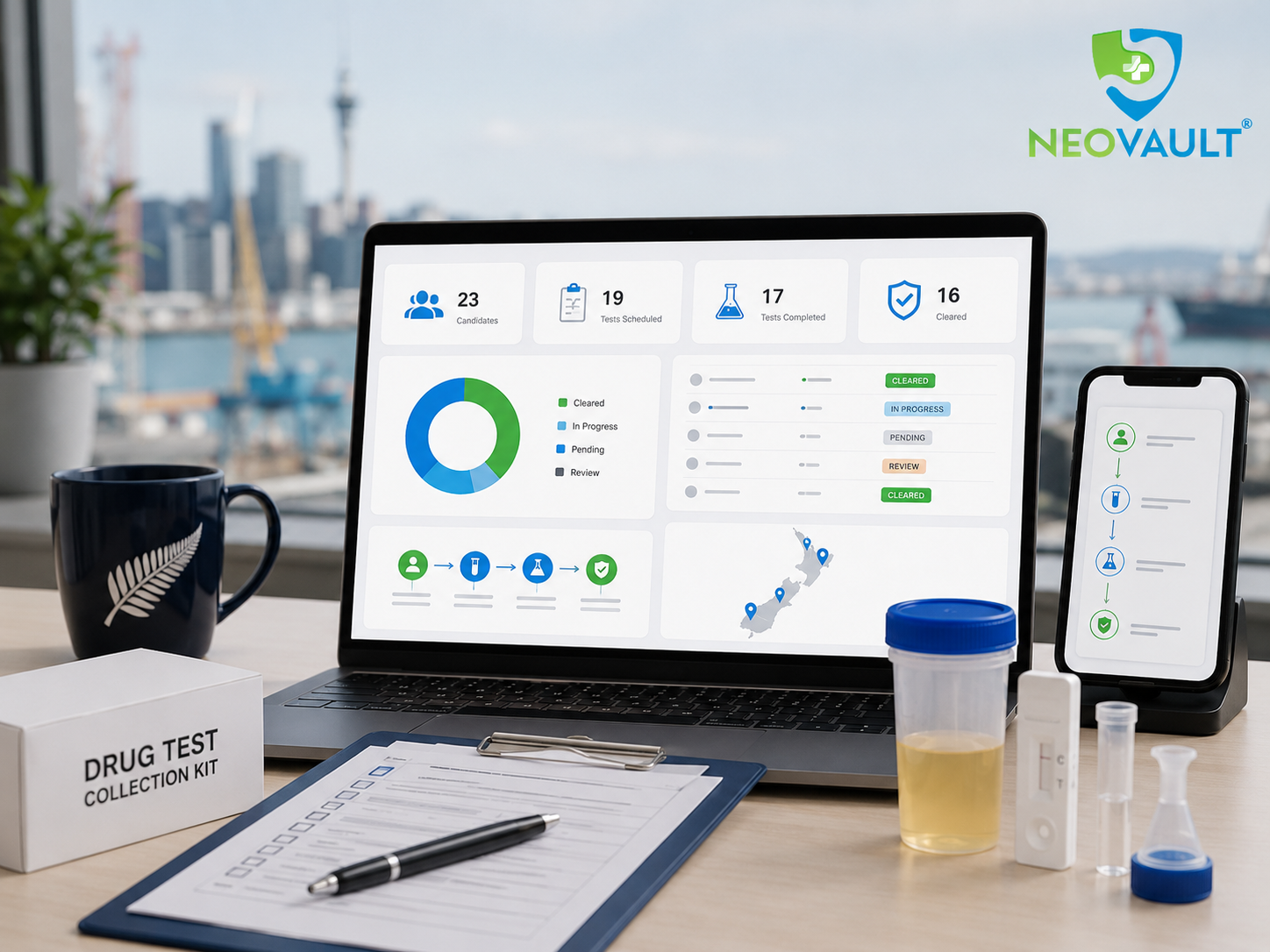
Managing the recruitment pipeline for hundreds of candidates requires absolute visibility. The NEOVAULT web portal provides safety and HR leaders with a live dashboard to track screening statuses across different clinics and worksites. This eliminates bottlenecks in the hiring process and ensures you have a permanent, audit-ready record before offering a candidate a contract.
Yes. Candidates can refuse to participate in a pre employment drug testing australia program. However, because screening is a lawful condition of the recruitment process for safety-sensitive roles, an applicant's refusal allows the employer to legitimately withdraw the job offer or cease evaluating their application without breaching employment laws.
The employer. In Australia, employers almost universally cover all costs associated with pre-employment drug and alcohol screening. Requiring candidates to pay for their own mandatory safety testing is bad industry practice and may violate award agreements or workplace fairness principles.
No. A non-negative initial result is not a confirmed positive. The sample must be sealed under a chain of custody and sent to an accredited laboratory for confirmatory analysis. A Medical Review Officer (MRO) will evaluate prescription declarations before any final recruitment decision is made.
Australian privacy and employment compliance guidelines recommend retaining pre-employment test records securely for at least 7 years. Using digital SaaS platforms like NEOVAULT ensures encrypted, HIPAA/ISO 27001 compliant cloud storage with automated audit trail capabilities.
Implementing a robust pre employment drug testing australia program is an indispensable strategy for protecting your workforce, securing your assets, and fulfilling your WHS legal duties. By adhering to Australian standards and establishing transparent policies, employers can confidently filter out impairment risks before they ever reach the site.
NEOVAULT provides the leading paperless management solution to secure this process. With our advanced digital drug and alcohol testing module and comprehensive fit-for-duty impairment screening capabilities, your organization can modernise its safety protocols effortlessly. Discover how NEOVAULT can digitise your workflow and help you maintain audit-ready compliance. Book a free platform demo with our safety specialists today.